
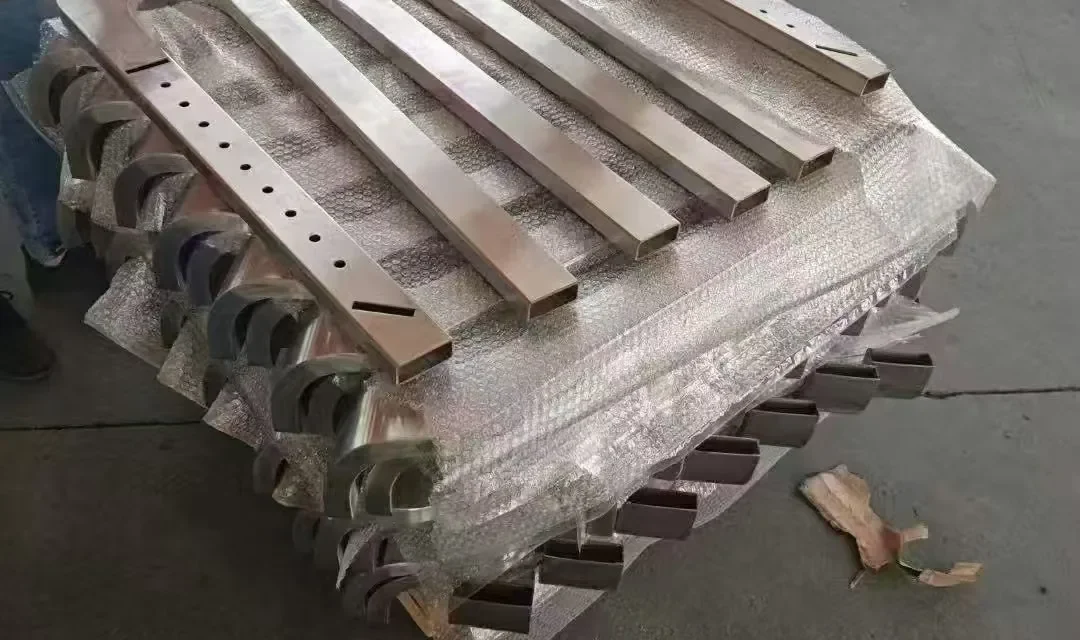
Specify factory-drilled stainless steel railing posts when attachment positions and connection details can be released before manufacture. Consider site drilling only where the actual connection design, access, tools, surface protection and inspection responsibilities have been agreed. Leaving a post undrilled transfers work and risk to the installation stage; it does not create unlimited adjustment or authorize the installer to choose a different fixing method.
Which holes are being discussed?
Separate holes in the post body from holes in a structural base plate, the supporting building and the glass. Each belongs to a different component and approval process. A clamp attachment hole through a tube wall is not an anchor hole in concrete. A clearance hole is not an internal thread, and neither establishes the adequacy of the complete connection.
This guide addresses the purchasing choice between defined factory preparation and agreed site preparation of a metal post. It is not a drilling procedure, structural design or permission to modify delivered products. BalusterPost manufactures stainless steel posts to approved drawings; the feasibility of a particular hole arrangement must be reviewed for that post and its intended fittings.
What does a factory-prepared post actually include?
A useful quotation identifies the finished connection rather than saying only pre-drilled. Ask whether the hole is a clearance opening, a threaded feature, an opening for an approved insert or part of a different documented attachment. Identify the face, height datum, axis and relationship to the base and adjacent fittings. These details determine whether the component arriving on site matches the intended assembly.
A first-party example illustrates the importance of product-specific instructions: WPS Handrails’ framed-glass assembly guide states that its referenced baluster posts already have a threaded hole and that drilling is not required for that step. This establishes what that particular assembly expects. It is not evidence that every railing post is pre-threaded or that its instructions apply to BalusterPost products.
How do the two procurement routes compare?
| Decision | Defined factory preparation | Agreed site preparation |
|---|---|---|
| Information needed | Released position and connection drawings before production | Approved connection plus a controlled method for establishing final positions |
| Inspection point | Before packing, with finished-part records | After the specified site work and before the assembly is released |
| Work ownership | Named preparation scope in the post order | Named contractor scope, tools and acceptance responsibility |
| Visible surfaces | Preparation and finishing sequence reviewed together | Protection, debris removal and any restoration agreed separately |
| Changes | Revised drawings before the affected batch | Written authorization before altering the delivered item |
Neither column is a universal recommendation. The comparison reveals which information and work must move with the chosen route. A low post-only quotation may exclude tasks that another offer includes, making headline prices misleading until both scopes are normalized.
When is factory preparation a useful purchasing choice?
Factory preparation is worth evaluating when the same released connection repeats across a batch and post identity can be maintained through packing and installation. For example, the buyer may have a fixed clamp model, an approved post schedule and a common finished-floor datum. The factory can then quote a defined feature set rather than an assumption about where an installer will later place the fitting.
Review the complete sequence. A correctly located opening can still be unusable if a bracket blocks access to its rear or the mating fastener conflicts with another attachment. Include the actual fitting and fixing reference in a representative assembly review. The square-tube glass balustrade post is a commercial starting point for drawing-based configuration, not a promise of a standard universal drilling pattern.
What makes site preparation a separate scope?
Site work needs an approved connection detail and someone accountable for executing it. Identify how the position is established, who verifies the underlying dimensions and what happens if the surveyed location differs from the drawing. Provide the installer with the applicable preparation instructions and acceptance criteria rather than leaving a generic note to drill as required.
Consider access with the post in its planned condition. A connection requiring access inside the tube may become inaccessible after a cap, handrail or adjacent component is installed. Conversely, a loose post may require a suitable holding arrangement before work begins. Resolve the sequence during planning; the buyer should not assume that any drilling task can be completed after erection.
How should the drawing describe the feature?
Use a feature schedule that links each opening to its purpose. At minimum, identify the post mark, drawing revision, face designation, position datum, hole or thread callout, mating component and acceptance reference. Show whether the feature passes through one wall or has another defined configuration. Avoid marking both faces identically if they perform different functions.
Threaded features require additional information beyond a nominal bolt diameter. The threaded post connection guide explains the distinctions between tapped walls, welded nuts, inserts and through-bolts. Changing among these arrangements is a design and supply decision, not a convenient response to a drill size available on site.
A worked purchasing example without invented dimensions
Suppose a distributor orders an intermediate post and an end post with the same external tube section. The intermediate post has glass connections on two specified faces; the end post has them on one. If the order says only drill for clamps, a supplier cannot reliably infer which positions belong to which mark. A shared photograph does not close that gap.
A better schedule uses separate marks, identifies each attachment face and references the approved clamp assembly. The buyer then asks for two prices on the same documented basis: the agreed factory preparation, and an explicitly defined alternative excluding that preparation. The second option must also identify who performs and inspects the remaining work. This example concerns scope clarity, not a recommendation to choose either route.
What should be checked before packing or installation?
- Verify the item mark and current drawing revision before checking features.
- Compare positions from the stated datum rather than from an arbitrary tube end.
- Confirm that the specified fitting and fastener can be assembled with the required access.
- Inspect the agreed edge condition, cleanliness and affected visible surfaces.
- Record deviations and obtain a disposition before the post is released.
Preserve original inspection records if a delivered hole appears incorrect. Enlarging or adding an opening before the issue is reviewed may remove useful evidence and change the connection. Keep the affected item identifiable while the responsible parties determine whether the drawing, manufacture, survey or assembly assumption needs correction.
What belongs in the enquiry?
Send the post schedule, released drawings, attachment references, installation sequence and intended preparation boundary through the project enquiry page. Ask the quotation to state exclusions as clearly as inclusions. If final positions are not yet available, identify the unresolved decision and its expected release point instead of treating uncertainty as an approved site instruction.
Factory and site drilling FAQ
Does an undrilled post provide more installation tolerance?
It leaves a feature unfinished. Any permitted positional adjustment still needs to be defined by the connection and project drawings; an undrilled surface does not establish an allowable range.
Can the installer copy a hole from another post?
Only an approved instruction can establish the relevant pattern. Another post may have a different mark, orientation or revision even if its outer dimensions look identical.
Is a successful trial assembly sufficient for release?
It demonstrates a particular fit check. Release also depends on the specified dimensions, connection details, surface condition and documented acceptance requirements.




