
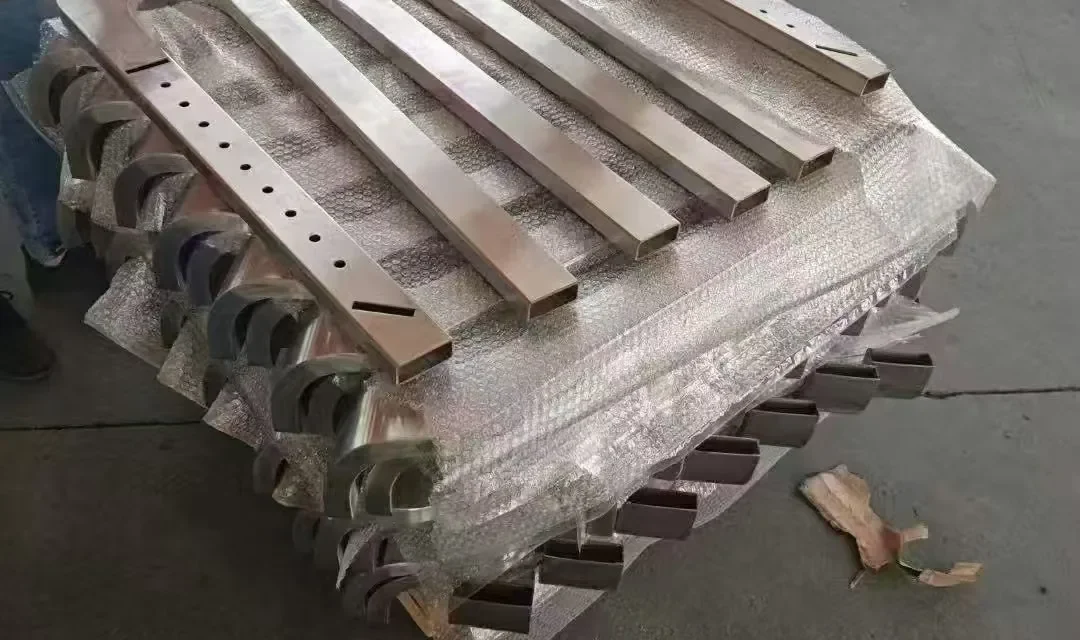
Estimate a stainless steel railing post’s mass from its actual material volume and the density of the specified grade, then add the separately identified plates, fittings and other included components. Keep theoretical body mass, complete-post net mass and packed gross mass separate. A tube calculation can support an early comparison, but it is not a verified shipping weight, a material certificate or proof of structural capacity.
Which weight does the buyer need?
A distributor comparing post quotations may need the approximate mass of the fabricated product. A freight forwarder needs package information. A receiving team may be checking a declared net mass against an actual shipment. These questions use different boundaries. Before calculating, identify the item, drawing revision and components covered by the requested figure.
Use mass in kilograms for the calculation described here. Commercial documents often call it weight, but a number labelled kilograms per post still needs a component boundary. Ask whether clamps, handrail supports, base plates, loose fixings and covers are included. Two suppliers can give different figures for the same visible post because they are counting different packages.
What is the basic calculation?
The theoretical mass is material volume multiplied by density. For a uniform tube body, material volume is the metal cross-sectional area multiplied by length. When dimensions are in millimetres and density is in kilograms per cubic metre, convert cubic millimetres to cubic metres consistently. Mixing unit systems can produce a much larger error than the geometric approximations.
Outokumpu’s Core range datasheet lists a density of 7.9 kg/dm³ for Core 304/4301. This is equivalent to 7,900 kg/m³, or 0.0000079 kg/mm³. The value is used below for an illustrative 304 calculation. It does not identify the grade of a delivered post or establish the density to use for every stainless steel alloy.
How can a square tube be estimated?
For an ideal square tube with sharp corners, outer side B and uniform wall thickness t, the metal area is B² − (B − 2t)². Multiply that area by the body length L and the chosen density in compatible units. This is a simplified geometry model; actual corner radii and manufacturing variation mean a real tube does not exactly match the ideal square section.
Use the same assumptions when comparing alternatives. Do not calculate one offer from nominal dimensions and compare it with another supplier’s weighed complete assembly as though both figures represent identical evidence. Retain the formula, inputs and component boundary beside the result so the estimate can be checked later.
A worked example with explicitly hypothetical dimensions
Assume an imaginary straight tube body with a 40 mm outer square, 2 mm uniform wall and 1,000 mm length. These numbers are arithmetic inputs only. They are not a recommended railing section, a verified BalusterPost model, an allowable tolerance or a statement of structural adequacy.
| Step | Calculation | Result |
|---|---|---|
| Ideal inner square | 40 − 2 × 2 | 36 mm |
| Metal cross-sectional area | 40² − 36² | 304 mm² |
| Body material volume | 304 × 1,000 | 304,000 mm³ |
| Estimated body mass | 304,000 × 0.0000079 | 2.4016 kg, approximately 2.40 kg |
The result concerns only the idealized tube body. It excludes plates, clamps, supports, screws, covers, packaging and geometric corrections. Reporting 2.4016 kg does not mean the finished product can be supplied or weighed to that precision. Round the commercial estimate appropriately and retain the unrounded arithmetic in the calculation record.
How do round tubes and flat bars differ?
For an ideal round tube, subtract the inner circular area from the outer circular area: π/4 × [D² − (D − 2t)²]. Multiply by length and compatible density. Use actual outside diameter rather than a nominal pipe designation. The distinction is explained in the tube outside-diameter guide.
For a rectangular flat bar of uniform section, the simplified volume is width multiplied by thickness multiplied by length. A fabricated post with multiple bars needs each piece counted. Cut-outs, tapers, curved profiles and other non-uniform features require their own volume treatment or a suitable model; a rectangular envelope would include material that is not actually present.
How should a complete post be built up?
Start with a component schedule. Identify the body, structural plate, welded attachments and any included removable fittings. Add the estimated or measured mass of each component on the same inclusion basis. Deduct removed material where relevant, and avoid counting an assembly once as a complete purchased item and again as its individual parts.
A comparison can use a simple column for quantity, unit mass, evidence type and included status. Mark figures as calculated, supplier-declared or weighed. If a fitting’s mass is unavailable, keep that line open rather than silently assigning zero. A partial total is useful when labelled as partial; it becomes misleading when presented as the complete post.
Why can the estimate differ from a measured item?
Actual section geometry, dimensional variation, machining, attachments and the precise boundary of the weighed item can all affect the comparison. First check whether the same object is being described. A body-only estimate and a post weighed with its clamps are not comparable until the additional components are accounted for.
For a genuine discrepancy, record the drawing revision, component list, weighing condition, scale identification and original result. Investigate the cause rather than altering the calculation merely to match the observed number. Do not treat mass alone as a substitute for dimensional inspection or grade verification: different combinations of geometry and components can produce similar totals.
Can lower mass prove a thinner wall?
Not by itself. A lower result may reflect a different body length, missing accessories, different geometry or another measurement boundary. If wall thickness is the concern, compare the specified feature using the agreed dimensional inspection method and actual drawing requirements. A mass comparison can prompt investigation, but it does not identify the cause without other evidence.
Likewise, a heavier post is not automatically stronger or compliant. Structural suitability depends on the complete design, connections and project requirements. Do not rank quotations by kilograms as though mass were a direct performance rating. Use mass to understand the supplied product and shipment, while retaining separate technical acceptance criteria.
How is shipping mass different?
Packed gross mass includes the identified goods and their packaging. A transport enquiry also needs package count and dimensions; a body calculation cannot establish those fields. Have the packing party provide the actual or appropriately qualified estimated package information, and update it when the final packing arrangement is known.
For multiple post types, keep quantities tied to their marks rather than multiplying one representative mass across the whole order. End, corner and intermediate configurations may contain different components. The order total should reconcile with the component and packing schedules without implying that every post is identical.
What should go into a weight enquiry?
- The post mark, drawing revision, material grade and quantity.
- The required boundary: body, complete post, kit or packed shipment.
- A component list identifying included and excluded accessories.
- The evidence requested: calculated estimate, supplier declaration or actual weighing.
- Units and any project-specific acceptance or documentation requirement.
The square-tube glass balustrade post is a drawing-based product, so its mass depends on the confirmed configuration. Send the relevant scope through the project enquiry page. BalusterPost manufactures stainless steel posts and coordinates related accessories through specialist manufacturing partners; a theoretical example is not a catalogue mass commitment.
Buyer FAQ
Can I use one density for every stainless grade?
Use a suitable published value for the specified material and identify the source. Do not infer an unknown material from a calculated mass.
Should a theoretical figure appear as certified shipping weight?
No. Identify its estimated status and scope. Final shipping documents need the information appropriate to the actual shipment.
Does an accurate tube estimate cover the complete post?
Only if all other included components and relevant geometry have also been accounted for. Keep the body result separate until that reconciliation is complete.




