
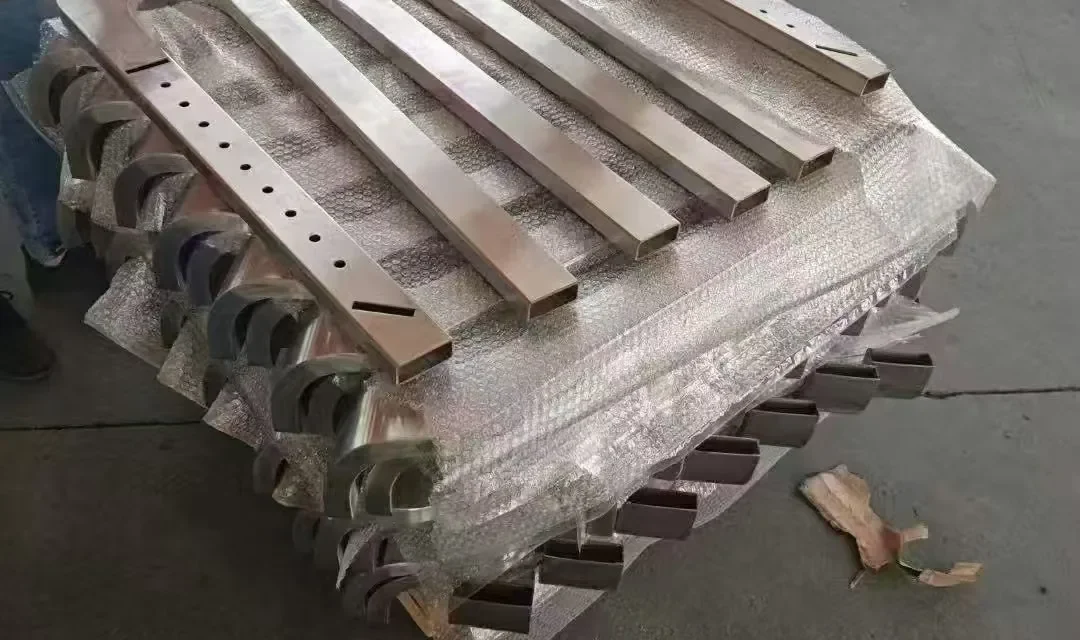
When stainless railing posts attach to a hollow steel stringer or edge member, review the receiving steel wall as part of the connection. Distinguish a fixing into one wall from a bolt passing through the entire section. Bolt strength, accessible nuts and a matching hole pattern alone do not establish the behaviour of the hollow support or approve the post attachment.
Identify the receiving member separately from the railing post
A square stainless railing post and a rectangular hollow steel stair stringer are different components with different jobs. The post drawing describes the supplied stainless assembly. The stringer drawing describes the supporting construction. A connection review needs both, with a section showing the faces that meet and the direction of the fixings.
Record the receiving member’s section dimensions, wall specification, material, orientation and nearby end conditions. Locate the proposed holes relative to its edges, welds and other connections. For an existing structure, establish what can actually be inspected rather than assuming the nominal external size reveals the wall thickness.
Choose a connection concept before finalising holes
The Steel Tube Institute’s discussion of through-bolts in hollow structural sections explains that bolts crossing an HSS section involve different wall and bolt behaviour from conventional connections with restraint at a single wall. It also discusses sleeves as one way to improve some through-bolt arrangements. This background does not provide a universal railing fixing capacity.
Ask the responsible connection designer to identify the intended concept: accessible single-wall bolting, a specified blind structural fixing, or a designed through-bolt arrangement. Do not interchange these simply because a bolt can pass through the drilled hole. Each concept has its own component requirements, installation conditions and structural checks.
Separate the checks that a bolt label cannot answer
| Connection feature | Buyer’s evidence request | Decision owner |
|---|---|---|
| Receiving wall | Section and wall specification at the actual fixing | Supporting-steel designer |
| Fastening concept | Named fixing and complete connection section | Connection designer |
| Internal detail | Any sleeve, stiffener or backing detail and installation route | Designer and steel fabricator |
| Post plate | Matching holes, bearing arrangement and orientation | Post supplier against approved detail |
| Access | Tool and nut access before member closure | Installation coordinator |
The table assigns evidence requests, not design capacities. Increasing a bolt property class does not automatically address local wall deformation, the geometry of a long through-bolt or the adequacy of surrounding steel. Keep those questions visible when comparing quotations with different attachment assumptions.
If a sleeve is specified, order the complete detail
An internal sleeve is not just an unspecified piece of tube added during installation. Where the approved design uses one, show its dimensions, material, location, fit and any joining requirements. Identify who supplies and installs it and whether the support must remain open during fabrication.
Do not tell the post manufacturer to guess this internal detail from an outside photograph. It may belong to the supporting-steel package. The commercial schedule should explain whether the stainless post order includes only the post and plate, or also particular connection parts made to the accepted drawing.
Example: the stringer end is capped earlier than planned
Consider an illustrative stair whose accepted connection uses a nut accessible inside the receiving member during fabrication. The steel fabricator caps the stringer before the railing work starts. The external post plate still aligns, but the installer can no longer place or inspect the nut in the agreed way.
Review the sequence before attempting another fixing. Cutting an access opening or substituting a blind fastener changes the supporting member or connection and needs the relevant approval. A purchase variation should identify the revised components and responsibilities, rather than describing the issue only as missing site access.
Include finish and dissimilar-material details
Record the supporting steel’s coating system and the specified interface with the stainless plate. Ask the project team to define any separation, sealing and coating repairs around drilled or welded areas. These details must remain compatible with the accepted bearing and fastening arrangement; a soft site-made packer should not silently replace a designed interface.
Distinguish alignment adjustment from structural changes. A hole that does not line up may indicate a survey or revision problem. Enlarging it, moving it or adding an extra plate changes the detail being supplied. Capture the proposed change with dimensions so the reviewer can assess the actual assembly.
Release a coordinated connection package
Provide the support section, fixing concept, installation access, component schedule and approved drawing revision. Link the substrate RFQ information to the specific hollow member. For stainless square-tube railing posts, use the enquiry channel to agree the manufactured post scope after the receiving connection has been defined.
This approach lets buyers compare like-for-like offers. It also prevents a complete-looking stainless post quotation from concealing missing internal work in the supporting steel package.




