
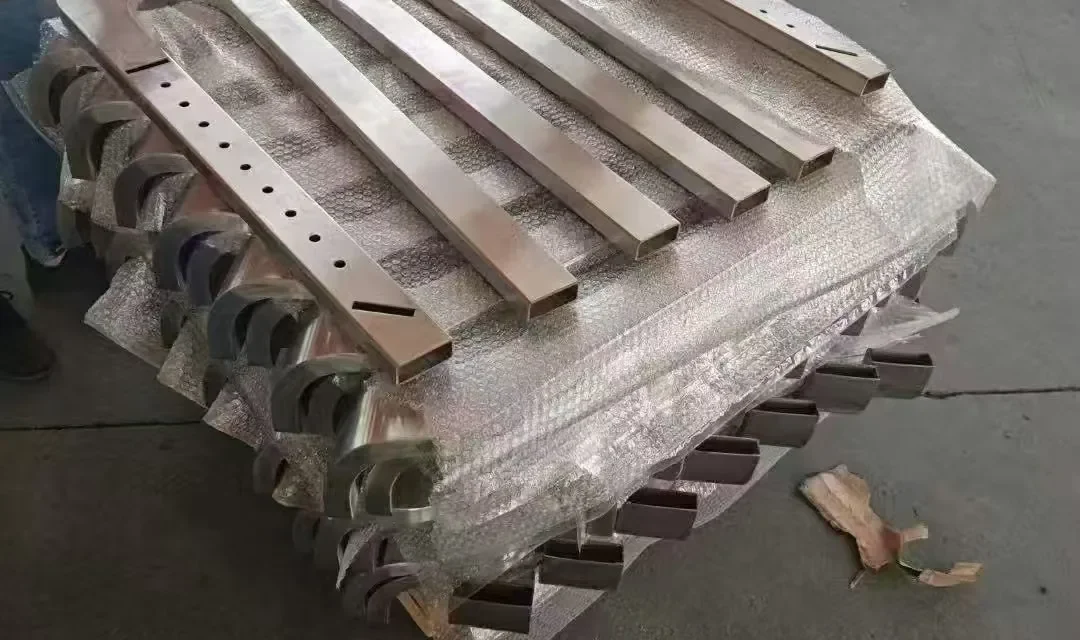
Before ordering stainless railing posts for a timber deck, locate each post against the structural framing beneath the deck boards. Review the approved blocking, connection and access detail before the decking hides it. A base plate that fits neatly on the finished boards does not establish that the framing can receive the guard loads or that its fasteners can be installed correctly.
Start with the framing plan rather than the board pattern
Deck boards define the walking surface. Joists, rim members, beams and their connections define the supporting construction. A proposed guard line can place one post over a joist, another between joists and a corner post beside intersecting members. Those positions may require different details even when the visible posts look identical.
Mark the proposed post centres on a plan showing joist direction, member locations, deck edge and stair opening. Add a section through each different support condition. Record the actual timber specification and condition for an existing deck; do not turn a photograph of painted boards into an assumption about hidden framing.
The American Wood Council’s DCA6 residential wood deck guide, based on the 2015 IRC, treats guard-post attachment and associated framing as specific details. Its prescribed timber arrangements have defined scope and local approval limitations. They provide context for reviewing load transfer; they do not certify a stainless base plate or establish current requirements for every jurisdiction.
Keep the stainless component and the timber connection on the same section
Show the post, base plate, deck boards, structural members and proposed fasteners together. Identify what supports the plate and where each fastener engages. Ask the responsible designer to resolve any unsupported span, finish gap or change in member position before the post plate is drilled.
Do not copy bolt sizes or blocking dimensions from a timber-post illustration into a metal-post order. Changing the post section, plate geometry and attachment arrangement changes the connection being assessed. A fixing supplier’s timber screw data also needs the correct material, embedment, spacing and connection configuration; a catalogue picture cannot complete that assessment.
Use a position-based coordination register
| Position condition | Information to capture | Release question |
|---|---|---|
| Post over a member | Member size, plate position and fixing route | Does the approved detail match the surveyed position? |
| Post between joists | Blocking and its connections to the framing | Is the complete support arrangement identified? |
| Corner or stair edge | Intersecting members and access restrictions | Has this distinct condition been reviewed? |
| Concealed underside | Installation and inspection sequence | Can the connection be completed before closure? |
Use the register to separate genuinely repeated positions from exceptions. Twenty identical post bodies can still meet several different framing conditions. Keep the post supply schedule linked to those conditions instead of treating the quantity as evidence that one fixing detail fits everywhere.
Inspect the concealed work at the useful moment
Arrange a hold point after the relevant framing and connection work is accessible and before deck boards, soffits or finishes conceal it. Identify who checks the work and what records are required. Useful photographs show the position label, surrounding framing and connection detail together; an isolated close-up of one screw does not locate the assembly.
Compare the installed members and blocking with the released drawing. Record discrepancies such as a service route occupying the intended fixing zone or a member shifted from the survey. Resolve the affected position before concealment. Photographing an unresolved discrepancy is a record of the issue, not permission to close the deck.
Example: a post is moved to align with a board joint
In an illustrative deck, the original post centre sits over the support shown in the approved detail. During layout, the installer moves it sideways to improve the appearance of a board joint. The plate still fits on the walking surface, but the fastener positions no longer match the original support.
Compare the revised position with the framing plan before drilling. The project team can assess whether to retain the original position, revise the framing or approve a different connection. Update the position schedule and affected fabrication drawing together. Do not solve the visual alignment on site while leaving the hidden connection based on the earlier layout.
Coordinate moisture and later access without inventing a fixing system
Ask the deck designer to address water management, timber treatment compatibility and the intended inspection route at the connection. A decorative cover can change visibility and maintenance access. It should not hide an undefined support condition. Keep any specified separation material and fastening details attached to the same approved assembly.
Use the substrate information guide to gather the wider project inputs. For square stainless railing posts, send the framing sections and position schedule through the project enquiry. BalusterPost manufactures stainless posts to the agreed scope; the deck connection requires its own project design and acceptance.
What should the buyer release?
Release a coordinated post drawing, position-to-detail schedule, approved framing connection and inspection sequence. Record any excluded anchor or timber work explicitly. This gives the installer a usable package and prevents a correctly manufactured stainless component from arriving at a deck whose hidden support was never resolved.




