
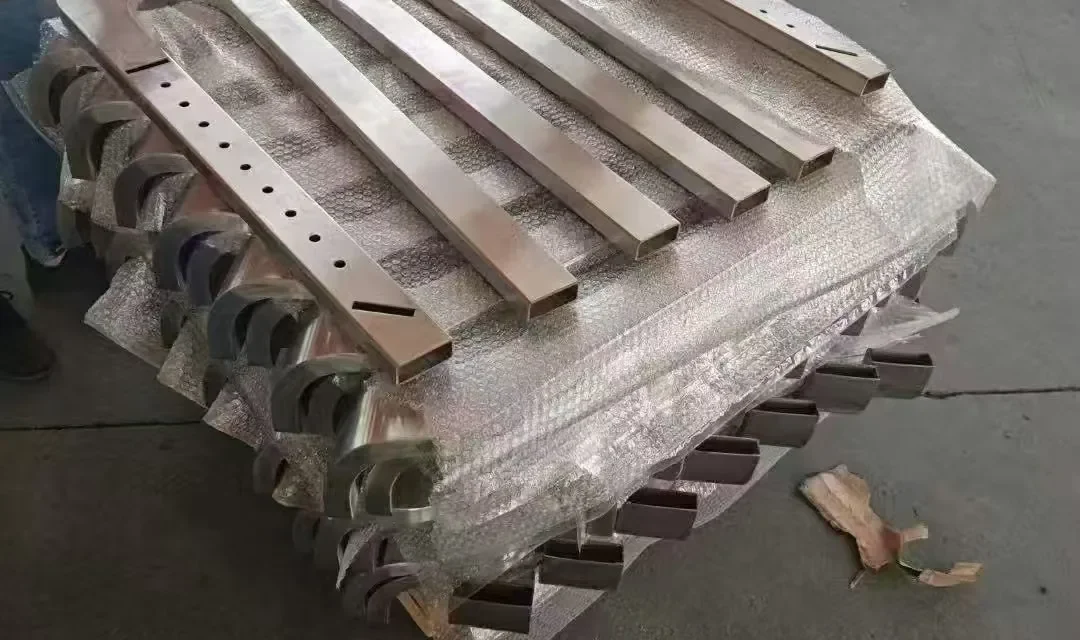
Review crevice corrosion risk on stainless steel railing posts by tracing where water can enter, remain and dry slowly around base covers, washers and overlapping surfaces. Discuss exposure, access and the complete connection detail before choosing a grade or finish. A more corrosion-resistant alloy can help, but the buyer still needs a documented way to manage sheltered interfaces and maintain the assembled railing.
Where should the review begin?
Start with a section through the connection in its final installed condition. Show the post, plate, cover, fasteners, adjacent surfaces and any gasket or isolation layer. A photograph of a finished railing may conceal the narrow spaces that determine how water behaves. The same cover can sit above an open, accessible connection on one job and surround a regularly wetted assembly on another.
Outokumpu describes crevice corrosion as localized corrosion associated with confined conditions and identifies chlorides as an important exposure factor for stainless steels. Its prevention guidance includes reducing tight crevices, stagnation and deposits. Use those mechanisms to ask where the post detail can trap moisture. The guidance does not establish a service life for a specific railing. Outokumpu corrosion guidance.
Separate the places that look alike from outside
| Interface | What to show in section | Buyer review |
|---|---|---|
| Decorative cover over base plate | Water entry routes, surrounding finish and removal access | Can a sheltered area be examined and maintained? |
| Washer or fastener head | Actual hardware stack and adjacent surfaces | Does the design consider the exposure at the bearing interface? |
| Isolation layer between materials | Its edge, attachment and material specification | Who reviews isolation and trapped-water conditions together? |
| Overlapping plate or bracket | Overlap limits and exposed edges | Where may deposits collect, and what access remains? |
Crevice corrosion and galvanic corrosion are different review questions. A material isolation detail is intended to address electrical contact under the specified conditions. The same detail also introduces contact surfaces that should be examined for confined water. Review both mechanisms on the same section. See the dissimilar-metal mounting guide for the isolation decision.
Compare two details under the same exposure
Imagine two post bases beside the same regularly washed exterior walkway. Both have the same specified grade. The first has a documented cover removal route and accessible surfaces. The second sits close to a raised finish with a hidden recess beneath its cover. Ask the team to show what happens to water in each assembled detail and how the operator reaches the concealed area. The comparison is about access and exposure. It does not establish that either arrangement will corrode in service.
When someone proposes sealing the perimeter, ask the designer to show all routes for water and the expected condition after maintenance. A change to one edge can affect how a concealed area dries or how a cover is removed. Where a gasket or seal is already specified, check compatibility and installation requirements for that particular assembly before proposing a material substitution.
Translate the review into order information
- Describe exposure by location, including regular washdown, sheltered corners and relevant salt sources.
- Attach the approved interface section and identify the cover, plate and fastener scope.
- State the material and finish separately for each relevant component.
- Include any approved access and maintenance instructions in the handover requirement.
The square-tube glass balustrade post provides a real product reference for the fabricated post. Send the connection section through the project enquiry page for review of the requested scope. BalusterPost manufactures stainless steel posts. Project exposure and connection requirements govern the material and interface details.
Buyer questions
Does a higher grade eliminate the need for access?
Access still matters for checking condition, removing deposits and carrying out the project’s maintenance instructions. Confirm grade suitability for the complete exposure.
Does rust staining prove crevice corrosion?
Appearance alone is insufficient. Record the location and surrounding detail, then have the condition assessed. Deposits and other corrosion mechanisms can produce different findings.
Can I specify a universal drainage opening?
Use the project detail. An opening can affect the cover, sealing strategy and other interfaces, so it should be reviewed with the assembled connection.




