
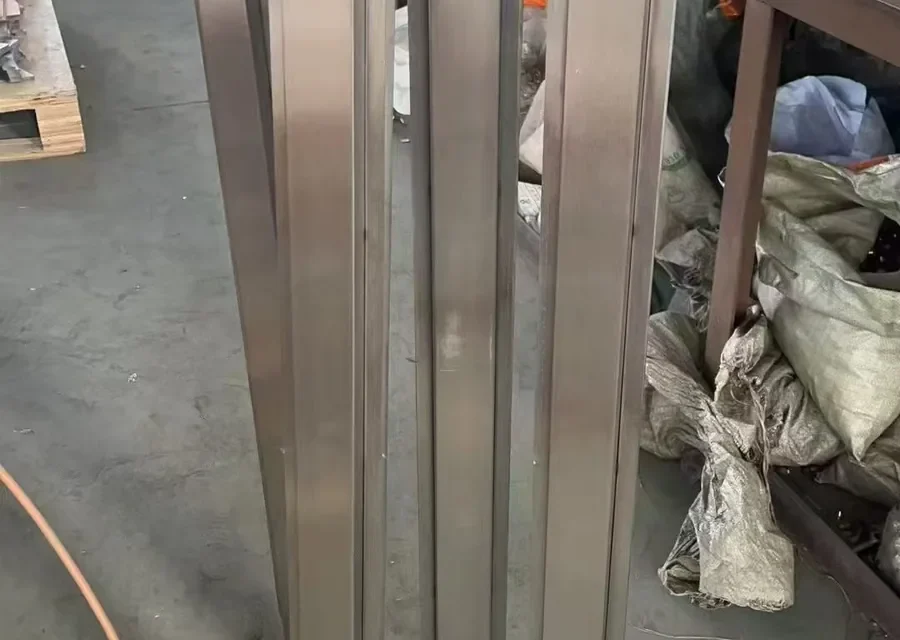
A stainless steel railing post can still develop a corrosion problem at its base when it contacts aluminium, galvanized steel or carbon steel in a wet detail. Review the whole mounting assembly: metal pairing, exposed area, water and salt exposure, drainage, isolating layers, fastener materials and inspection access. The post grade alone cannot establish the durability of the joint.
Why can a stainless post have a corroded mounting interface?
When an isolation layer also creates a sheltered contact area, review the separate crevice corrosion risk at post bases.
The post tube may remain sound while a neighboring metal corrodes, a fastener stains the visible finish, or moisture trapped beneath a cover creates a crevice. Those outcomes have different causes and remedies. Calling every brown mark “stainless steel rust” can lead buyers to request the wrong change.
The British Stainless Steel Association’s galvanic-corrosion guidance explains that dissimilar metals must be electrically connected and bridged by a conductive liquid for a galvanic cell to operate. Dry contact alone does not create galvanic corrosion. A base that is repeatedly wet, especially with chloride-bearing water, deserves more attention than a permanently dry interior detail.
What is galvanic corrosion at a railing-post base?
Galvanic corrosion is accelerated attack on the less noble metal in an electrically connected pair when an electrolyte completes the circuit. With stainless steel joined to aluminium or galvanized steel, the aluminium or zinc coating can be the vulnerable side. The result depends on exposure, surface-area ratio, coatings and the exact geometry; a simple metal-ranking table cannot predict service life by itself.
The worldstainless corrosion overview identifies galvanic and crevice corrosion as different mechanisms and points to the importance of material combinations. For procurement, that means a post drawing should identify not only the stainless alloy but also the plate, bracket, anchor, washers, sleeves and adjacent metal.
Which three conditions should a buyer check?
| Condition | Question for the site or drawing | Possible control |
|---|---|---|
| Dissimilar metals | Which metals touch at the base, bracket and fastener? | Review compatible materials and protective finishes |
| Electrical path | Do bolts, plates or damaged coatings bridge the metals? | Specify a complete isolation detail when required |
| Conductive moisture | Can rain, wash water or salt solution remain at the joint? | Provide drainage, access and a maintenance plan |
Removing one condition can interrupt the galvanic mechanism. For example, a sound insulating system may break the electrical path. It must include the actual contact surfaces and fastening path, not only a visible pad beneath the base plate.
Does stainless steel touching aluminium always fail?
No. The BSSA notes that surface-area ratio matters: a small stainless fastener in a much larger aluminium component can perform differently from a small aluminium fastener holding a large stainless component. Local exposure matters too. An uninsulated detail that works in a dry sheltered location should not automatically be copied into a marine or de-icing-salt environment.
Do not assume that a nominal “316L post” solves an aluminium corrosion problem. Upgrading the stainless alloy may improve its resistance to some local environments, but it does not remove electrical contact, the electrolyte or an unfavorable area ratio. The designer should review the complete pair and the installation conditions.
How do galvanized and carbon-steel parts change the review?
Galvanized steel has a zinc coating that may be consumed more rapidly in an adverse wet couple; uncoated carbon steel can also corrode and deposit staining products on adjacent stainless surfaces. The BSSA says galvanized steel and stainless steel contact is not normally a serious risk in many ordinary conditions, while severe marine conditions may justify insulating barriers. The conclusion is site-specific, not a blanket approval.
If a railing post fixes to a painted steel bracket, document the coating system and what happens at cut edges, drilled holes and fastener bearing faces. If a stainless base plate bears on concrete, identify any embedded steel or exposed metal plate as part of the interface. The post manufacturer needs an approved mounting definition; the project engineer must assess the supporting structure and anchor design.
How can the joint be isolated correctly?
Potential methods include a non-conductive barrier between metal faces, sleeves in bolt holes and suitable washers beneath heads and nuts. Coatings can also separate metals when their coverage and durability are properly detailed. The BSSA corrosion-mechanisms guidance lists barriers, coatings, washers and bushes as possible controls.
Every isolation material needs project approval for compressive behavior, long-term exposure, fire or other building requirements where relevant, and compatibility with the anchor system. A soft gasket that compresses unpredictably may change clamp force or base alignment. Do not specify insulation as a substitute for structural review.
Show the full stack-up in section: base plate, barrier, substrate or bracket, sleeves, washers, anchor, nut and cover. Include the interface in the installation drawing and first-article review. A note reading only “isolate dissimilar metals” is difficult to inspect on site.
What about water trapped beneath the cover plate?
A decorative cover can hide standing water, salt deposits and corrosion of the anchor or neighboring metal. It may also create a tight crevice on the stainless surface itself. Galvanic and crevice corrosion are separate mechanisms, but the same poorly drained detail can enable both.
The BSSA’s external-building guidance advises avoiding moisture traps and crevices at mechanical fixings. Design the cover and mounting area so water can leave, cleaning is possible and inspection is not impossible. Sealing may be useful in some approved details, but a failed seal can trap moisture; the chosen approach should be shown and maintained as a complete system.
Does a higher stainless grade remove the need for drainage?
No. A grade with better chloride resistance can be appropriate for aggressive exposure, but geometry still matters. Stagnant salt solution beneath a cover, deposits on a horizontal plate and poorly maintained crevices can challenge even a higher-grade post. Grade selection and drainage should be reviewed together.
For a material discussion, see the 304 versus 316L baluster-post guide. Specify the grade of the tube, base plate, weld filler and relevant fasteners consistently with the project’s corrosion assessment. Do not infer alloy from appearance.
Which mounting interfaces should be drawn separately?
Top-mounted, side-mounted and fascia-mounted posts expose joints to water differently. A top plate may collect deposits on a horizontal surface; a side bracket may have a concealed contact face; a fascia connection may create a runoff path across another material. Identify the actual location and orientation for each post variant.
The mounting-method guide explains the geometry to provide for each approach. For corrosion review, add the neighboring metal and coating, the path of runoff, access to fasteners and the inspection plan. A representative core product is the FG1 square stainless steel post; its final base and fixing remain subject to the project drawing.
What should be inspected before and after installation?
- Identify all metals and coatings in the approved base assembly.
- Check that isolating pads, sleeves and washers match the drawing and have not been omitted.
- Inspect coating continuity, cut edges and exposed carbon-steel surfaces.
- Confirm anchor type, hole geometry and bearing surfaces against the engineer’s detail.
- Check that the base and cover do not trap water in the installed orientation.
- Verify that cleaning and inspection access remain available.
- Record visible staining, white deposits, coating damage or standing water during maintenance.
- Refer movement, anchor degradation or significant corrosion to the responsible project professional.
These checks do not establish structural adequacy. They help the buyer and installer confirm that the approved corrosion-control detail was actually supplied and assembled. Photos of the exposed base before the cover is fitted can be useful for future maintenance.
What should a buyer put in the RFQ?
Provide the installation environment, location of each post type, substrate and adjacent metal, mounting drawings, proposed anchor system, corrosion-protection specification, water-management detail, grade and finish requirements, quantity, inspection records and acceptance authority. Identify whether the buyer expects the post supplier to supply isolation components or only to fabricate the post to a prepared interface.
BalusterPost focuses on manufacturing stainless steel baluster and railing posts, with business coordination based in Taizhou, Jiangsu, China. Ryan Liang is the Export Manager. Related anchors, glass clamps and other accessories can be coordinated through qualified specialist manufacturing resources; they are not described as BalusterPost’s in-house manufactured products. Send the approved interface and open questions through the BalusterPost enquiry page.
Frequently asked questions
Can a stainless post and aluminium bracket be used together?
They can be in a suitable, approved detail. Review moisture, metal-area ratio, coatings, isolation and the project’s exposure before deciding whether direct contact is acceptable.
Is brown staining proof that the stainless tube is corroding?
No. Staining may come from adjacent carbon steel, embedded iron, runoff or corrosion of a different component. Identify the source before choosing a remedy.
Are plastic washers enough to isolate the base?
Not by themselves if metal faces, bolt shanks or other components still bridge the joint. Review the complete electrical and structural path.
Should a cover be sealed completely?
There is no universal answer. The designer should choose a detail that manages water and remains inspectable, considering what happens if the seal ages or fails.
Who approves the anchor and corrosion-control assembly?
The responsible project designer and relevant local approval parties define the structural and durability requirements. The manufacturer can produce and document the specified post interface.




