
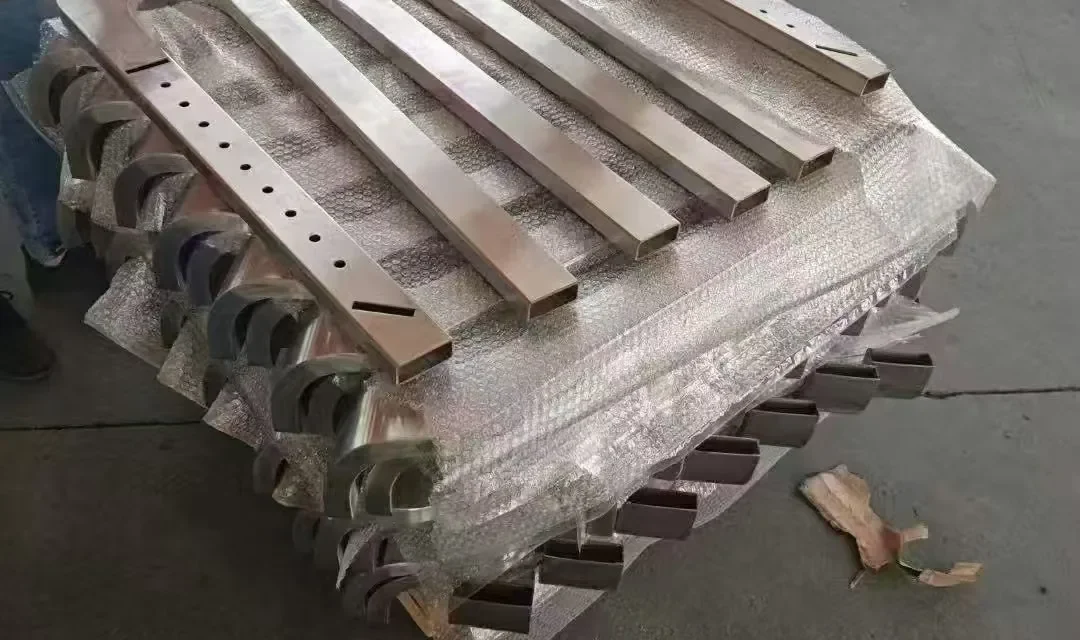
Order stainless steel railing posts near a building movement joint only after the project designer has defined how the railing accommodates relative movement. Identify which substrate supports each post, where the glass and handrail runs stop, and which connections are fixed or movement-capable. A generic slotted base plate or an adjustable glass clamp is not evidence that the complete railing can accommodate building movement.
Why does a building joint matter to a railing buyer?
For an arithmetic check of free length change within a continuous rail run, see the stainless steel handrail thermal expansion guide.
A railing order can look complete on an elevation while its supporting construction remains unresolved. Two adjacent posts may stand on different structural sections. A continuous handrail, a glass panel or a rigid connector may then cross the boundary. The purchasing problem is not simply choosing the next post in a standard spacing schedule. It is identifying whether the supplied assembly follows the project’s movement design.
This guide addresses procurement coordination, not a calculation method or an installation approval. Required movements, load paths and connection details must come from the responsible project designer. There is no universal joint gap, post setback or sliding connection suitable for every balcony, terrace or stair. Do not derive those dimensions from a photograph of another building.
BalusterPost’s core manufacturing scope is stainless steel baluster posts and railing posts, coordinated from Taizhou, Jiangsu, China. Related glass clamps are supplied through qualified specialist manufacturing resources. Neither a post quotation nor coordinated accessory supply replaces project engineering. Start with the relevant stainless steel post category and identify the particular location requiring review.
Is thermal expansion the same as building movement?
No. Thermal expansion describes a material’s dimensional response to temperature change. A building movement requirement can involve other project-specific actions and relative movements between supporting elements. The railing designer needs the applicable design information, rather than an assumption that outdoor temperature is the only concern.
The Design Manual for Structural Stainless Steel commentary hosted by BSSA discusses the different thermal properties of austenitic stainless steel and carbon steel, including their implications for welding distortion. Those material properties are not a railing joint design. Do not treat a material reference as permission to choose the gap or connection arrangement without project review.
For procurement, the useful conclusion is to request a project-defined movement detail. Naming a stainless grade does not explain how the entire assembly moves. The post, its supporting structure, the handrail and the infill must be considered together by the people responsible for the design.
What information should the designer provide?
Issue a marked plan showing the movement-joint line, post centres, substrate boundaries and the extent of each railing run. Include a section where the relationship is not clear in plan. Identify the supporting element for every affected post; a dimension from an architectural finish is not always a clear description of the structural support.
Ask the designer to state the relevant movement directions and design conditions in the approved project documents. Purchasing staff should not convert a broad description such as flexible connection into an unapproved fabrication detail. Where the information is outstanding, label the affected items as requiring design release rather than allowing a supplier to fill the gap silently.
The drawing should identify discontinuities in the glass and handrail, any approved movement-capable components, and how adjacent components are prevented from interfering. It should also identify the evidence or instructions applicable to those components. A component name alone is insufficient if several variants have different functions.
Which interfaces need separate decisions?
| Interface | Question for the approved design | Procurement record |
|---|---|---|
| Post to supporting construction | Which structural section supports the post? | Location and substrate reference |
| Post base connection | Is movement intended here or elsewhere? | Released connection drawing |
| Glass to posts | Does a panel span the joint boundary? | Panel schedule and approved interfaces |
| Handrail between posts | Where does continuity stop or movement occur? | Joint component and installation detail |
| Adjacent finishes | Can trim or sealant obstruct the intended action? | Coordinated architectural detail |
This table is a coordination checklist, not permission to introduce movement at every connection. The designer determines where the assembly is fixed and where relative displacement is accommodated. The order should reproduce that decision consistently across the post drawing, glass schedule and accessory list.
Why are ordinary slots and adjustable clamps insufficient evidence?
A slot can be included for positioning during installation, while an adjustable fitting can be intended to establish a final angle. Neither description establishes that movement is permitted after installation. Ask for the exact product’s intended function and approved installed condition. Do not loosen a connection, enlarge a hole or remove a restraint to create an improvised movement allowance.
Likewise, available physical space is not the same as verified movement capacity. A gap visible on a drawing may be needed for assembly, a finish transition or another purpose. Its adequacy under the project’s conditions must be confirmed through the design process. Buyers should record the approved requirement, not assign engineering meaning to an unexplained dimension.
Use the existing base-plate guide for the information needed to define the connection itself. A movement-joint review adds the relationship between neighbouring support zones and the connected railing run; it does not replace those base-connection requirements.
How should the RFQ separate standard and special posts?
Give affected posts distinct schedule references even when their visible finish matches the rest of the project. State whether the difference is in the post geometry, attachment arrangement, mating component or installation detail. If the physical posts are identical, the schedule can still identify their distinct location and assembly instructions without inventing a different manufactured part.
Ask the supplier to quote only against the released design scope. If a detail remains provisional, separate it as an unresolved item and identify the information needed to finalise it. A complete price for the rest of the railing should not be interpreted as technical approval of the outstanding joint.
Record who supplies any proprietary movement component and who confirms its compatibility with the post interfaces. If supplied by another contractor, obtain its controlled dimensional information before releasing the mating post. Procurement coordination should prevent two parties from each assuming that the other owns the missing interface.
What should be checked before fabrication release?
- Match the joint location across structural and architectural drawings.
- Assign each affected post to its actual supporting section.
- Confirm glass-panel boundaries and handrail continuity.
- Identify approved special components and their supply responsibility.
- Resolve attachment dimensions, orientation and installation sequence.
- Release one coordinated revision and retain the approval record.
Check drawing revisions particularly carefully after a site layout change. Moving a post can alter its relationship to the joint even when the post’s own dimensions do not change. The repeat-order revision guide explains how to retain the link between approved information and the manufactured batch.
What belongs in the handover package?
Retain the approved joint detail, affected post references, component instructions and records of approved site changes. Identify any access or inspection requirements specified by the designer or component supplier. The receiving team needs to distinguish a special connection from a standard one before parts are distributed across the site.
At handover, unresolved interference or a departure from the approved arrangement should be referred to the responsible designer. Do not conceal it under trim and treat a visually continuous railing as proof of correct function. Photographs can document the installed arrangement, but they do not establish performance by themselves.
Buyer questions answered
Can a glass panel cross a building movement joint?
That requires a project-specific approved design. Do not assume it is acceptable because the panel fits between the post centres or because the clamps are described as adjustable.
Does a stainless steel grade determine the required gap?
No. Material properties are only part of the information. The supporting structure, assembly arrangement and project movement requirements must be considered together.
Can a supplier quote before the joint detail is complete?
The supplier can identify the unresolved scope and quote defined items separately. Production of affected interfaces should wait for the necessary approved information.
For a drawing-based enquiry, contact Ryan Liang, Export Manager, with the post schedule, marked joint location and released interface details. State which design decisions remain open so the enquiry does not imply that unconfirmed geometry is ready for manufacture.




