
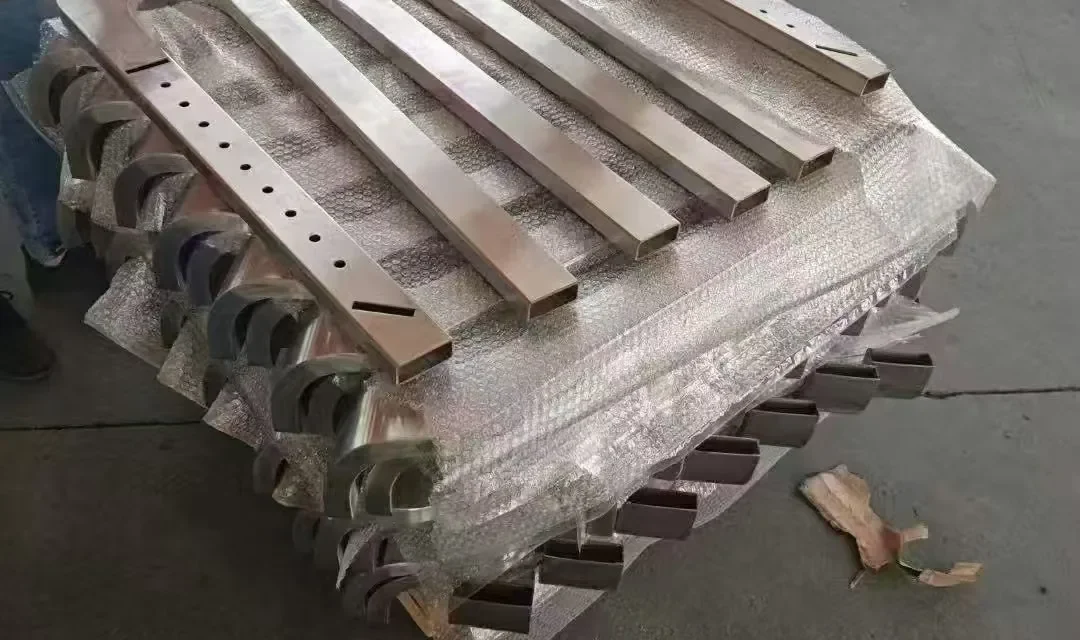
A one-piece railing post base cover and a split cover require different installation planning. Before ordering, check how the cover reaches its final position around the post, whether fittings block that route, and how it can be removed for later access. Select the actual cover geometry with the base assembly. A decorative cover should not be treated as a repair for an unresolved post connection or as evidence of structural capacity.
What is the difference between a one-piece and a split cover?
A one-piece cover has a continuous opening around the post. Its installation route must allow that opening to pass over the relevant part of the assembly. A split cover separates into components that join around the post, subject to its particular fixing design. The split line and joining method therefore become part of the appearance and access review.
Use these terms to describe the proposed component, not to assume that every manufacturer supplies both versions. AGS Stainless lists a split base plate cover with an installation video for its own railing system. That is an example of a defined split-cover product; its fit and installation method do not establish compatibility with another supplier’s post.
Why should the cover be considered before the handrail is fitted?
A continuous cover opening needs a physical installation path. A welded support, projecting glass adapter or completed handrail connection may obstruct the route shown in the cover’s intended installation sequence. The buyer should ask how the supplied cover is positioned rather than assuming it can be added at any stage.
The answer depends on the actual assembly. A cover may be supplied already placed around a post, installed before projecting fittings are attached, or handled through another documented sequence. Those are possibilities to resolve with the supplier, not universal instructions. Do not dismantle a completed railing solely to fit trim without an approved work plan.
Compare the complete installation and maintenance routes
| Decision | One-piece cover | Split cover |
|---|---|---|
| Initial positioning | Confirm a clear route for the continuous opening | Confirm how the separate parts join around the post |
| Nearby fittings | Check anything the cover must pass during installation | Check space required to position and connect the parts |
| Appearance | Review opening fit, visible edges and finish | Review those items plus split-line position and joining details |
| Later access | Identify permitted movement or removal within the assembled railing | Identify access to the specified joining or retention features |
| Replacement | Resolve whether the original installation route remains available | Confirm that the offered replacement matches the existing assembly |
This comparison is a buyer coordination aid. It does not guarantee that a split cover can always be removed easily or that a one-piece cover is always difficult to maintain. Read the selected product’s details and check the space around the installed post.
How should internal clearance be specified?
The cover must be reviewed against the complete agreed connection envelope, including the post-to-base joint and the items the cover is intended to conceal. Identify the structural plate, specified anchor heads, washers and any other approved components on a section view. Use their assembled positions rather than comparing only the plate’s outside dimensions.
Record cover height, internal shape and opening geometry on its drawing. Check the fit at the finished floor interface as well as at the post. A cover that fits over an isolated plate may still conflict with another component in the completed connection. Do not solve that conflict by changing an anchor, washer or structural detail without the responsible review.
What does a cover opening around the post need to show?
Identify the actual post section and the matching cover opening. For square posts, include corner geometry where it affects the fit. For round posts, identify the intended outside diameter. An opening described only as suitable for a nominal post size leaves the reviewer without the complete mating geometry.
For a square tube glass balustrade post, coordinate the cover with the ordered assembly drawing. A catalogue post family does not automatically define a particular cover. If a proposed finish or component revision changes the offered fit, document it before treating the previous approval as unchanged.
Do covers establish a waterproof connection?
A decorative cover’s presence does not by itself establish a waterproofing detail. Refer to the project’s specified water-management arrangement and the selected components’ instructions. Identify whether the cover is intended to conceal, protect or simply finish the appearance of a separately designed interface.
Do not assume that filling the space under a cover with an unspecified sealant creates the required detail. If sealing is specified, record the product, contact surfaces, preparation and future access implications through the appropriate project review. The cover order should follow that resolved arrangement rather than concealing an unanswered question.
How should the split line and retention method be reviewed?
Ask for the orientation of the split line and the location of any visible joining or retention features. Compare that view with the architectural finish requirement and nearby obstructions. A fastener placed against a wall or another fitted component may need a different access review from the same cover on an open floor.
Record the actual joining method shown on the product drawing. Do not describe a clip, screw or other retention feature as interchangeable without supplier confirmation. If the cover is supplied as matched pieces, keep its identification and packaging clear so installers do not mix parts from different references or revisions.
Example: replacement trim on an existing railing
Consider an illustrative enquiry for a damaged cover on a railing whose handrail and glass fittings remain installed. The buyer first photographs the post, cover and surrounding space. A proposed replacement should then be checked for its mounting geometry and available positioning route, rather than selected only from the visible external outline.
If a split replacement is proposed, identify its part reference and connection details. Confirm appearance and access as well as fit. This is a hypothetical procurement example, not a BalusterPost customer case or a promise that a split replacement exists for every installed post.
What should a sample inspection include?
Review the cover on a representative post base assembly. Check its installed position, intended visible surfaces, permitted access and specified retention arrangement. Use the agreed floor reference or a clearly identified representation of it so the review does not ignore the final interface.
The base plate and cover plate guide explains the wider separation between the structural connection and its trim. Keep acceptance of cover appearance distinct from approval of the base plate, welds and anchorage.
A focused RFQ checklist for post covers
- Post type, actual section and assembly drawing revision.
- Base connection envelope and finished-floor reference.
- One-piece or split construction, with the offered product reference.
- Cover opening, external size, height and internal geometry.
- Positioning sequence and clearance around projecting fittings.
- Retention method, visible split line and access requirements.
- Material and finish requirements, with a visual reference where needed.
- Quantity, matched components, sample approval and packaging identification.
Identify missing information explicitly. A response that lists an offered cover without a compatible assembly detail is a proposal still needing review, rather than proof that installation and future access have been resolved.
How BalusterPost can coordinate the enquiry
BalusterPost manufactures stainless steel baluster posts and stainless steel railing posts, coordinated from Taizhou, Jiangsu, China. Associated hardware can be sourced through qualified specialist manufacturing resources, with its supply scope identified separately. This guide does not claim that both cover constructions are available for every post model.
Use the post base plate component page as a related catalogue reference and send the actual post-and-cover details through the BalusterPost enquiry page. Request confirmation of the offered construction and unresolved interfaces before accepting the order.
Frequently asked questions
Can a one-piece cover always be added after installation?
No. Check whether the completed assembly leaves the intended positioning route available.
Does a split cover automatically fit an existing post?
No. Its opening, internal envelope, retention arrangement and available access must match the actual assembly.
Does the cover replace base connection inspection?
No. The structural connection and decorative trim require their own relevant checks.




