Choose between post-mounted and glass-mounted handrails by identifying which component supports the rail and how its connections are coordinated with the guard design. A rail carried by metal posts has a different interface from a cap or fitting supported by glass. Define that support arrangement before ordering posts, glass or brackets; a similar finished appearance does not make the underlying assemblies interchangeable.
Is the visible top rail the same as a handrail?
Project terminology matters. A top rail describes its position in an assembly, while a handrail has a grasping function governed by the applicable project requirements. The same member may perform both functions in a particular design, but a photograph alone does not establish that. Ask the designer to identify the required functions and show the component that performs each one.
The National Glass Association’s 2023 Glass Use in Guardrails paper distinguishes handrails, guards and balusters and discusses top-rail provisions under the 2021 IBC. It is useful background for terminology, not a universal approval for a proposed assembly. The adopted local code, project design and applicable edition must be established separately.
What is a post-mounted handrail interface?
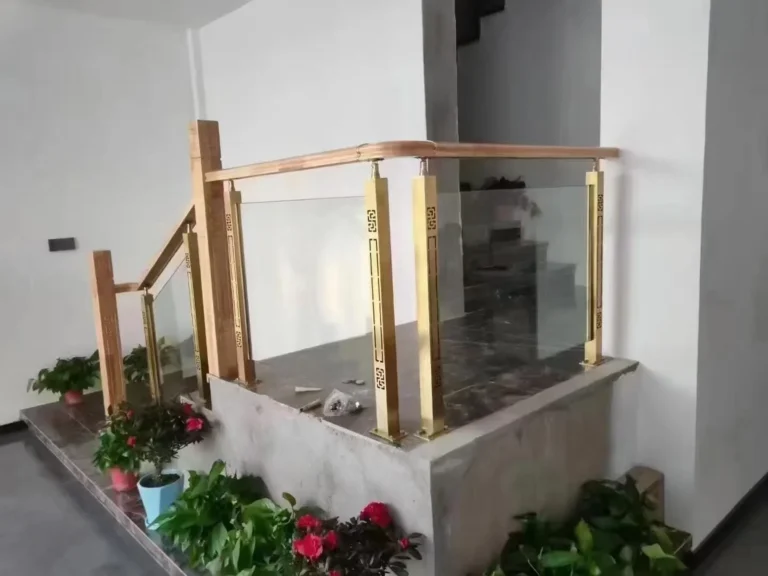
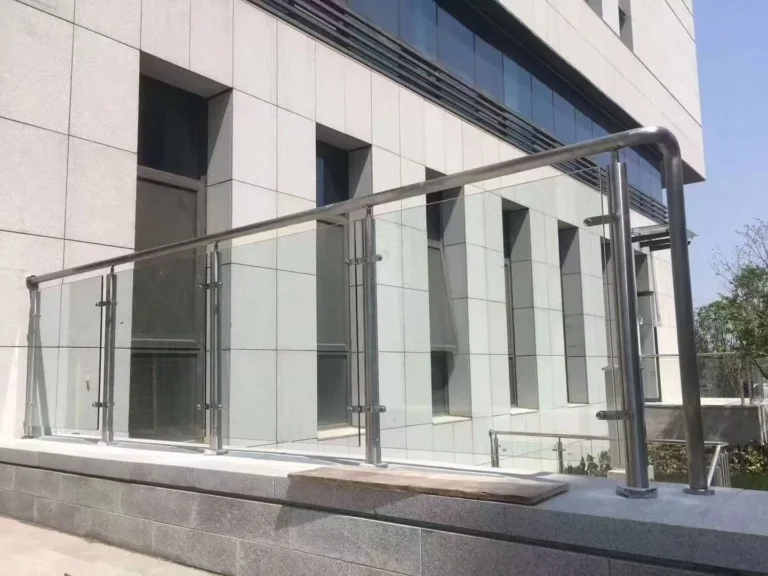
In the arrangement discussed here, the rail connects to defined supports on metal posts. The purchase scope therefore needs the rail section, support shape, attachment method, orientation and relevant connection dimensions. The post and rail schedules must agree at intermediate positions, corners, ends and changes in slope. A support supplied on a post does not by itself identify the entire handrail package.
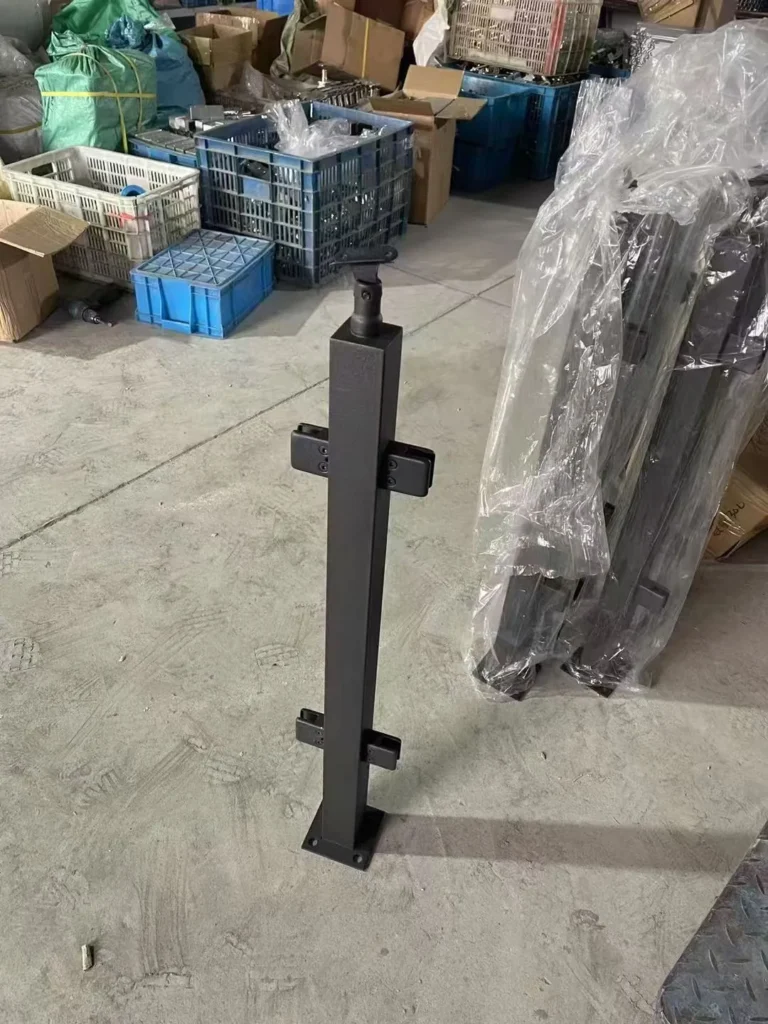
The BP-SQ01 square-tube glass balustrade post is shown with a handrail saddle and glass fittings, with configuration confirmed to approved drawings. Treat that as a starting point for interface discussion. Do not infer a particular rail diameter, connector range or structural capacity from the image.
What changes when the rail is supported by glass?
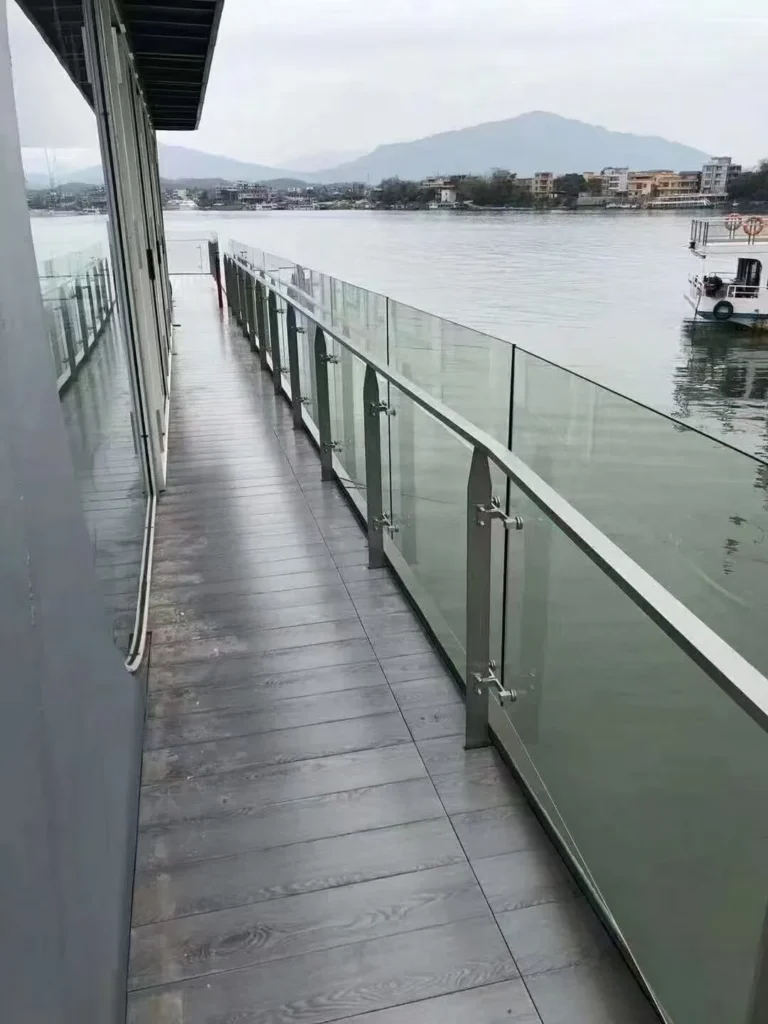
A glass-mounted rail or cap connects through a specified glass interface rather than simply using the same post saddle in a different location. The glass edge, associated fitting, any insert or bonding arrangement and the rail section become a coordinated package. Responsibility for that package must be clear before the glass is released for fabrication.
Metal posts may still exist elsewhere in the guard, or the project may use another support system. The key procurement question is where this particular rail receives its support. Avoid ordering components from two different concepts because the architectural image shows only a continuous line at the top. A cap profile and a post-mounted rail can look similar at a distance while requiring different details.
Which information moves with each option?
| Coordination item | Rail supported by posts | Rail supported through glass |
|---|---|---|
| Primary interface to identify | Rail to post support and support to post | Rail or cap to glass and associated fittings |
| Geometry to coordinate | Post positions, support orientation and rail junctions | Glass edges, joint arrangement and specified cap connection |
| Supply boundaries | Posts, supports, rail lengths, connectors and fixings | Glass, cap or rail, inserts, connectors and specified fixing materials |
| Review at a change of direction | Support and rail connection at corner or stair transition | Glass arrangement and rail connection at that transition |
| Evidence required | Approval for the complete specified guard and rail assembly | Approval for the complete specified guard and rail assembly |
The final row is deliberately the same. Moving a rail from a post to the glass does not remove the need to verify the complete system. Nor does a metal support automatically establish compliance. Buyers should compare documented arrangements rather than assign a safety ranking to two product photographs.
How should a drawing show rail height and post height?
Show the controlled rail reference separately from overall post length. A rail support may project above the post body, and its connection may have a defined installation position. If one party dimensions to the tube end while another dimensions to the rail surface, both can produce internally consistent drawings that do not describe the same finished assembly.
Identify the reference surface at the start of the schedule and use it consistently at level runs, stairs and landings. Do not add a universal rail height to resolve an incomplete drawing. The appropriate height and measuring convention are project matters. The purchasing task is to ensure that the post, support and rail documents use the approved convention without hidden changes.
Why should corners and stair transitions be reviewed early?
A straight sample demonstrates only a straight arrangement. At a corner, the rail joint and support may compete for the same space. At a stair transition, a rail may change slope while adjacent glass edges and post positions follow their own geometry. Review these junctions as actual assemblies with identified components rather than extrapolating from the middle of a level run.
Use an enlarged detail for each distinct junction. Mark the rail connection, support direction and assembly access. Include wall returns or termination components where they occur. This makes the enquiry more accurate and helps reveal whether an accessory is missing from the commercial offer before the project reaches the installation stage.
Can an adjustable support solve an unresolved drawing?
An adjustable component has the functions and limits defined for its actual model. It is not evidence that arbitrary height, angle or alignment changes are possible. Obtain the drawing and instructions for the proposed support, then compare its documented adjustment with the movement needed by the project. Record the final setting or acceptance reference where required.
The handrail support purchasing guide addresses support details. This article adds the earlier decision about whether the rail should be carried by those post supports at all. Resolve that decision before selecting an accessory by its shape or advertised adjustability.
A practical comparison for a distributor enquiry
Consider an architectural sketch with glass panels and a continuous upper rail but no connection sections. A distributor could quote posts with saddles and assume the rail connects to them. A glazing subcontractor could simultaneously assume a cap mounted on the glass. The two offers might each appear complete while leaving an incompatible combination in the overall order.
Ask for one coordinated section and a package boundary list before comparing prices. State which component carries the rail, which party supplies each connector, and which drawing governs the end and corner details. This is a scope example, not an engineering solution. It shows why a small clarification at enquiry stage can prevent a much larger procurement mismatch.
What should be included in the final package?
- A section identifying the rail support route and required function.
- Post, glass and rail schedules with matching revisions and reference dimensions.
- Details for corners, stairs, wall connections and terminations.
- Component references, supply responsibilities and applicable installation instructions.
- The project-specific design and verification documents required for release.
BalusterPost manufactures stainless steel posts and coordinates related accessories from qualified specialist manufacturing partners. Send the coordinated scope through the project enquiry page. Availability of a particular rail fitting or glass-mounted accessory must be confirmed; the comparison above is not a catalogue of guaranteed supply.
Buyer FAQ
Can a top rail be omitted because the glass is laminated?
That cannot be decided from the material label alone. The responsible designer must evaluate the adopted requirements and the documented complete assembly.
Can a rail originally supported on posts be moved onto the glass?
Treat that as a change to the assembly. Obtain the appropriate design, component and glass review before revising the order.
Which option is always cheaper?
There is no reliable universal answer. Compare the same project scope, including glass interfaces, junctions, accessories, installation work and required evidence.