
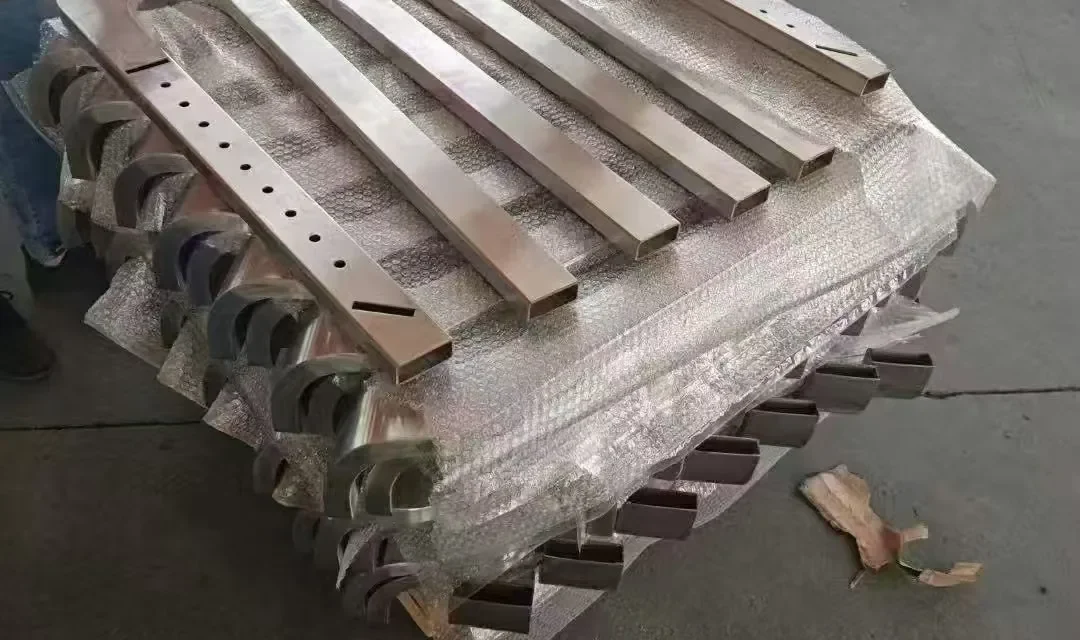
Order stainless steel glass railing posts by their position in the approved layout: end posts terminate a run, intermediate posts connect adjacent panels along a run, and corner posts connect panels where the direction changes. These names describe a role, not a universal drilling pattern. Before ordering, assign each position a drawing reference, glass-connection orientation, base orientation and handrail detail so visually similar posts cannot be substituted by mistake.
What distinguishes an end post, an intermediate post and a corner post?
In this guide, an end post is a post at the termination of a glass-panel run. Its glass connections usually serve the panel on one side. An intermediate or line post serves panels continuing along the run. A corner post serves a change in direction. These are practical purchasing descriptions; the actual connection arrangement must come from the selected system and approved drawings.
The distinction matters because the tube or flat-bar body can look identical in a catalogue photograph while the finished assemblies are different. Glass attachments may face different directions, the handrail support may be rotated, and a base plate may need a particular orientation. An order for a single total quantity of “stainless steel posts” hides those differences and makes picking, inspection and installation harder.
BalusterPost manufactures stainless steel baluster posts and railing posts, with business coordination in Taizhou, Jiangsu, China. Related glass clamps and other accessories can be coordinated from qualified specialist manufacturing partners. For a coordinated package, identify the manufactured post and the partner-sourced fittings separately in the position schedule.
Can a standard intermediate post be used at the end of a run?
Do not assume it can. A post with connections on both sides may leave unused holes, protruding fittings or an unwanted visual detail at a termination. Removing a fitting is not automatically an approved conversion: the hole treatment, appearance, connection arrangement and product specification still need agreement. Specify an end configuration when that is what the drawing requires.
Also distinguish a free end from an end next to a wall. The latter may involve a separate glass-to-wall interface, a handrail return or access restrictions for assembly. A post placed near a wall is not necessarily the same fabricated part as the free-standing end of another run. Record the termination detail rather than relying on the word “end.”
A buyer comparing square stainless steel glass railing posts should therefore review the complete assembly drawing. The square profile alone does not specify which faces receive glass attachments or how the terminal handrail is finished. The same ordering principle applies to round and flat-bar post bodies.
Why do corner posts need a plan view?
A plan view shows the directions of the adjoining panels and the relationship between the post, base and surrounding construction. “Corner post” alone does not define the corner angle, whether the turn is internal or external from the chosen viewing side, or the position of the glass relative to the post centreline. Show those relationships explicitly.
Do not assume every corner must use one shared post. Depending on the selected railing arrangement and project design, the corner may use a shared post or separate posts for adjoining runs. That choice affects panel interfaces, the handrail junction, installation space and the quantity schedule. The project designer should settle the arrangement before the supplier releases fabrication drawings.
For a shared corner post, show each attachment face and its elevation. Nearby fittings can compete for assembly access, particularly where two panels meet. A drawing review and, where agreed, a mating sample can identify a physical mismatch. Neither is a substitute for the engineer’s assessment of the installed guard, its glass or its anchors.
How should left-hand and right-hand versions be identified?
Use left and right only with a defined viewing direction. Two people looking from opposite sides of a balcony can reverse those labels. A more reliable procurement record combines a position mark with a plan-view arrow, a nominated reference face and the direction of each glass connection. Keep the convention identical in the layout, fabrication drawing and packing list.
For example, a buyer may call one termination E-A and the other E-B. Those labels are illustrative and do not identify existing BalusterPost stock products. If the drawing review confirms that both positions use an identical part, they can share a fabrication part number while retaining separate installation position marks. If the bases or attachment faces differ, preserve separate part numbers.
This distinction between a part number and a position mark helps distributors as well. A part number identifies a repeatable manufactured configuration; a position mark identifies where it belongs on a particular project. Combining them into one ambiguous label makes repeat purchasing and replacement requests more difficult.
What belongs in a post-position schedule?
| Schedule field | What to record | Why it matters |
|---|---|---|
| Position and role | Unique mark; end, line, corner or transition | Connects the physical post to the layout |
| Fabrication identity | Part number, drawing number and revision | Separates genuinely different assemblies |
| Glass interfaces | Attachment directions, elevations and fitting references | Prevents incompatible panel connections |
| Mounting interface | Base orientation, hole pattern and agreed datum | Relates the post to the mounting drawing |
| Top connection | Handrail support direction, termination or transition detail | Controls the upper assembly |
| Order controls | Quantity, material, finish and packing identification | Supports quoting, inspection and delivery checks |
The table is an ordering aid, not a dimensional specification. Heights, spacing, section dimensions, glass details, anchors and acceptance tolerances must be supplied or approved for the project. A supplier should not derive them from a generic product photograph. The post drawing and tolerance guide explains how to make the inspection basis explicit.
When the glass clamp is purchased separately, nominate the exact fitting and its post interface. When it is coordinated with the post, identify the fitting source and who checks compatibility. In both cases, distinguish the post-to-fitting connection from the fitting-to-glass connection. The supplier needs the relevant approved details for each interface.
Should all positions use the same material and finish?
A consistent material and finish specification across a visible run can simplify procurement, but it must still suit the exposure and design. The British Stainless Steel Association’s guidance for external building applications considers site environment, local conditions, surface finish, design and maintenance when selecting stainless steel. A position name such as “corner” does not determine the appropriate grade.
Specify the agreed grade and finish on every part family or through an unambiguous common note. Avoid mixing a catalogue description such as “satin” with a different approved sample on the same order. For visible adjoining parts, agree the appearance reference and finishing direction where relevant. Any change in material or finish should be reviewed before it becomes a substitute in production.
If the order requests SUS304 or SUS316L, define the applicable material designation and required evidence rather than treating those names as a complete engineering specification. The position schedule controls identity; it does not establish corrosion performance, load capacity or compliance of the completed railing.
How can buyers check a mixed batch before shipment?
First, reconcile the approved layout with the schedule and quotation. Count each configuration by its drawing reference, then compare those quantities with the order total. Resolve any blank positions or unexplained extra parts. A total that matches can still conceal too many line posts and too few corner posts.
Second, agree inspection and identification before production. Check representative configurations against their drawings, including attachment direction, base orientation and top connection. The first-article inspection guide provides a framework for agreeing what to inspect and who approves it. Record which variants the approval actually covers instead of assuming one sample covers every orientation.
Third, connect packing identification to the same part numbers and position schedule. Ask for a packing list that lets receiving staff reconcile quantities without unwrapping every protected finish. Agree how identification is applied so it remains readable without damaging visible surfaces. Retain the approved drawing revision with the order records for future replacement enquiries.
Frequently asked questions
Are end and corner posts always different sizes?
No. They may share the same body size while using different attachment faces, bases or top details. Compare the complete assembly drawings before deciding they are interchangeable.
Can one corner post serve any change of direction?
No universal capability should be assumed. The intended angle, glass connections and mounting arrangement need confirmation for the exact assembly. An adjustable fitting also needs its permitted use and interface checked.
Should spare posts be ordered as one generic type?
Specify which approved configurations the spares must replace. A spare intermediate post may not replace an end or corner assembly. Agree spare quantities commercially rather than applying an unsupported percentage to every project.
What should I send to request a quotation?
Send Ryan Liang, Export Manager, the layout and post schedule, together with fabrication drawings, quantities, material and finish requirements, fitting details and destination. Mark unresolved interfaces clearly so they can be discussed before the quotation becomes a production instruction.




