
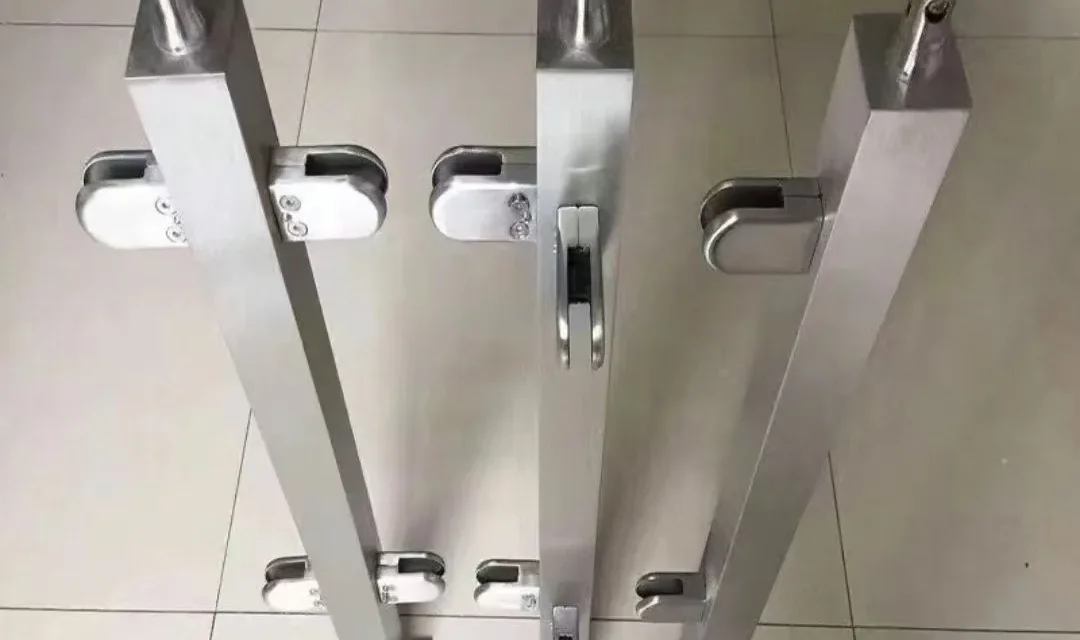
To source replacement stainless steel railing posts, treat the original post as an interface-controlled assembly—not as a tube with a similar appearance. Record the mounting pattern, post geometry, glass and handrail connections, material requirement, finish, orientation and surrounding site constraints. Then decide whether the order requires exact interchangeability, a compatible redesign or replacement of an entire railing run.
Why are replacement railing posts difficult to match?
A railing post connects several systems at once. Its base fixes to the structure; clamps or adapters locate the infill; a saddle supports the handrail; the post body establishes height and alignment; and the visible finish must sit beside existing metalwork. A new post can look similar in a photograph yet fail at one of these interfaces.
Existing installations also contain variation. Site holes may not match the original drawing, glass panels may have been adjusted during installation, and a brushed surface may have changed through wear, cleaning or exposure. Buyers therefore need both product information and site evidence before requesting a firm replacement quotation.
First decide what “replacement” means
| Replacement objective | What must match | Main risk |
|---|---|---|
| Exact interchange | All controlled interfaces, orientation and visible geometry | An undocumented dimension prevents installation |
| Compatible single-post redesign | Existing anchors, glass, handrail and adjacent alignment | The new detail works alone but conflicts with neighboring posts |
| Replace one complete railing run | Structural connection, glass/infill, handrail and project appearance | Scope expands without a coordinated site design |
| Visual match only | Profile, finish and visible proportions | Appearance is accepted while functional interfaces are missed |
State the objective in the RFQ. “Same as photo” is not an interchangeable-part requirement. If exact interchange is necessary, every critical interface needs a dimension, tolerance or approved physical reference.
What evidence should a buyer collect?
Begin with the highest-quality evidence available. The preferred order is an approved drawing, an unused original sample, a removed serviceable post, and then a controlled site survey. Photographs support these records but rarely replace them.
A useful evidence pack includes:
- overall photographs showing the complete railing run and post positions;
- close-ups of the base, cover, anchors, glass fittings and handrail support;
- a reference scale in photographs, plus separately recorded dimensions;
- the original drawing, bill of materials, purchase order or supplier code if available;
- one clearly identified sample with notes about damage, wear or modification;
- project location and exposure conditions;
- required quantity, handed variants and installation deadline;
- the responsible party for structural and regulatory approval.
Do not measure only the damaged post. Compare at least one unaffected location where possible. A bent body, elongated anchor hole or reworked fitting can otherwise be mistaken for the original design.
Which dimensions control interchangeability?
Measure from functional datums. For a top-mounted post, the base-plate mounting face can establish the vertical datum; a defined post face or centerline can control rotation and lateral location. For a fascia-mounted post, the mounting face, edge distance and bracket offset usually need particular attention.
Record the post profile and wall, finished height, base-plate size and thickness, anchor-hole pattern, hole or slot dimensions, clamp centers, handrail-support height, saddle angle, projection from the post, cover dimensions and any drainage or access features. For stair posts, identify direction of ascent, slope and left/right orientation.
ISO 129-1:2018, confirmed current by ISO after review in 2023, establishes general principles for presenting dimensions and associated tolerances on technical drawings. Applying a consistent drawing method reduces ambiguity, but it does not select the correct tolerances for the project. The designer must determine which dimensions are functional and how much variation the mating parts permit.
Our railing-post drawing and tolerance guide explains datum selection, hole centers and handed variants in more detail.
How should mounting details be surveyed?
Do not remove a post until the site team has assessed safety and temporary protection. Once access is authorized, record what is hidden by the base cover: anchor type, hole pattern, plate seating, grout or shims, waterproofing, edge distance, drainage and tool access. Note whether the existing substrate or anchors show movement, corrosion or damage.
A replacement post should not be used to conceal an unresolved substrate problem. Anchor selection, structural adequacy and local code compliance remain project-design matters. The manufacturer needs the approved interface, not assumptions based on a photograph.
Use the mounting-method guide to distinguish top, side and fascia mounting before preparing the survey.
How do material and tube requirements affect the replacement?
Specify the required stainless grade and product form rather than asking the supplier to identify alloy from color. If original material records are unavailable, the buyer should decide what verification is required and who will approve the result. Appearance alone cannot reliably distinguish common stainless grades.
For welded mechanical tubing, ASTM A554-26 is the current ASTM specification and covers round, square, rectangular and special-shape stainless mechanical tubing for applications where appearance, mechanical properties or corrosion resistance is needed. Referencing the standard is useful only when the order also identifies the applicable grade, dimensions, finish and any required supplementary provisions.
The article 304 vs 316L stainless steel baluster posts provides a starting point for material discussions. Final selection must reflect the actual environment, maintenance plan and project specification.
Can a new brushed finish exactly match an aged railing?
Not always. “Satin” or “brushed” is too broad for a controlled match. Define the visible face, grain direction, target appearance, comparison lighting and acceptable variation. If surface roughness is a controlled requirement, state the measurement method and location separately from the visual sample.
An aged railing may have changed through cleaning, abrasion, deposits or corrosion. A new production sample can be compared with a protected or representative area, but the buyer should approve the match under realistic viewing conditions. Do not promise an invisible repair before reviewing the actual site and an approved finish sample.
What must be checked around glass and handrail fittings?
Record the fitting type, center location, projection, fastener, glass thickness range, gasket arrangement, panel-hole relationship and installation access. A clamp body that appears identical may use a different fastener or glass seat. If the original fitting is discontinued, replacing the post and fitting together may be safer than mixing unverified parts.
For the handrail connection, document saddle shape, rail profile, angle, fixing holes, offset and whether the support is fixed or adjustable. Stair and transition posts often need unique angles. The railing-post types guide and the FG1 square stainless steel post page show how post form and fitting layout should be treated as one configuration.
Should the supplier copy a used sample directly?
A used sample is evidence, not an automatically approved master. First identify wear, bending, field-drilled holes, repaired welds, replaced fittings and dimensional changes. Mark which features are intentional and which are damage.
Convert the accepted geometry into a controlled drawing. The drawing should define the revision, units, datums, material, finish, critical dimensions, tolerances, fitting interfaces and inspection points. Both parties can then review the same production definition instead of repeatedly interpreting the sample.
How should a replacement sample be approved?
- Verify the drawing revision and replacement objective.
- Check the mounting template against the approved survey or master fixture.
- Measure post height, fitting centers, offsets, angles and orientation.
- Assemble the approved glass fittings and handrail components.
- Compare finish, grain and visible geometry with the approved reference.
- Conduct a controlled trial installation where project conditions require it.
- Record deviations and obtain written disposition before batch production.
- Retain the approved drawing, sample photographs and inspection record.
Approval should not rely only on whether the post can be forced into place. Shimming, slot enlargement or field drilling can hide an interface error and create a different product from the approved design.
Replacement railing-post RFQ checklist
- replacement objective: exact interchange, compatible redesign or full-run replacement;
- quantity and breakdown by straight, corner, end, stair and handed variants;
- approved drawings, sample status and site-survey evidence;
- post profile, wall, height, base and cover details;
- glass, infill and handrail interfaces;
- stainless grade, tube specification and verification requirement;
- finish reference, grain direction and visual acceptance method;
- critical tolerances and inspection records;
- sample, trial-fit and production-release sequence;
- packing identification by location or post type;
- responsibility for anchors, engineering and code approval.
What can BalusterPost review?
BalusterPost focuses on manufacturing stainless steel baluster posts and railing posts, with business coordination based in Taizhou, Jiangsu, China. Buyers can submit drawings, dimensioned photographs and available samples for manufacturability review. Related glass clamps, handrail components and other hardware are coordinated through qualified specialist manufacturing resources rather than presented as BalusterPost-made products.
A review is not a substitute for site measurement, structural design or local approval. Send the evidence pack through the BalusterPost enquiry page, and identify unresolved dimensions instead of filling gaps with estimates.
Frequently asked questions
Can a replacement post be made from photographs only?
Photographs can support an initial review, but they normally do not control scale, hidden interfaces or tolerances. A dimensioned drawing, verified survey or approved sample is needed before production release.
Should one damaged post or the complete run be replaced?
That is a project decision. Consider interface compatibility, condition of adjacent components, finish variation, availability of matching fittings and the responsible designer’s assessment.
Can existing anchor holes be reused?
Only when the project’s responsible party confirms the substrate, anchor condition, geometry and required performance. The manufacturer should receive an approved mounting interface rather than assume reuse is acceptable.
Is a physical sample better than a drawing?
They serve different purposes. A sample reveals construction and appearance; a controlled drawing states the production definition and acceptance requirements. The strongest replacement package uses both when available.
How can replacement posts be identified during installation?
Use a packing list and durable part-location labels that correspond to the approved drawing schedule. Separate straight, corner, end and handed stair variants so installers do not discover the differences after unpacking the entire shipment.




