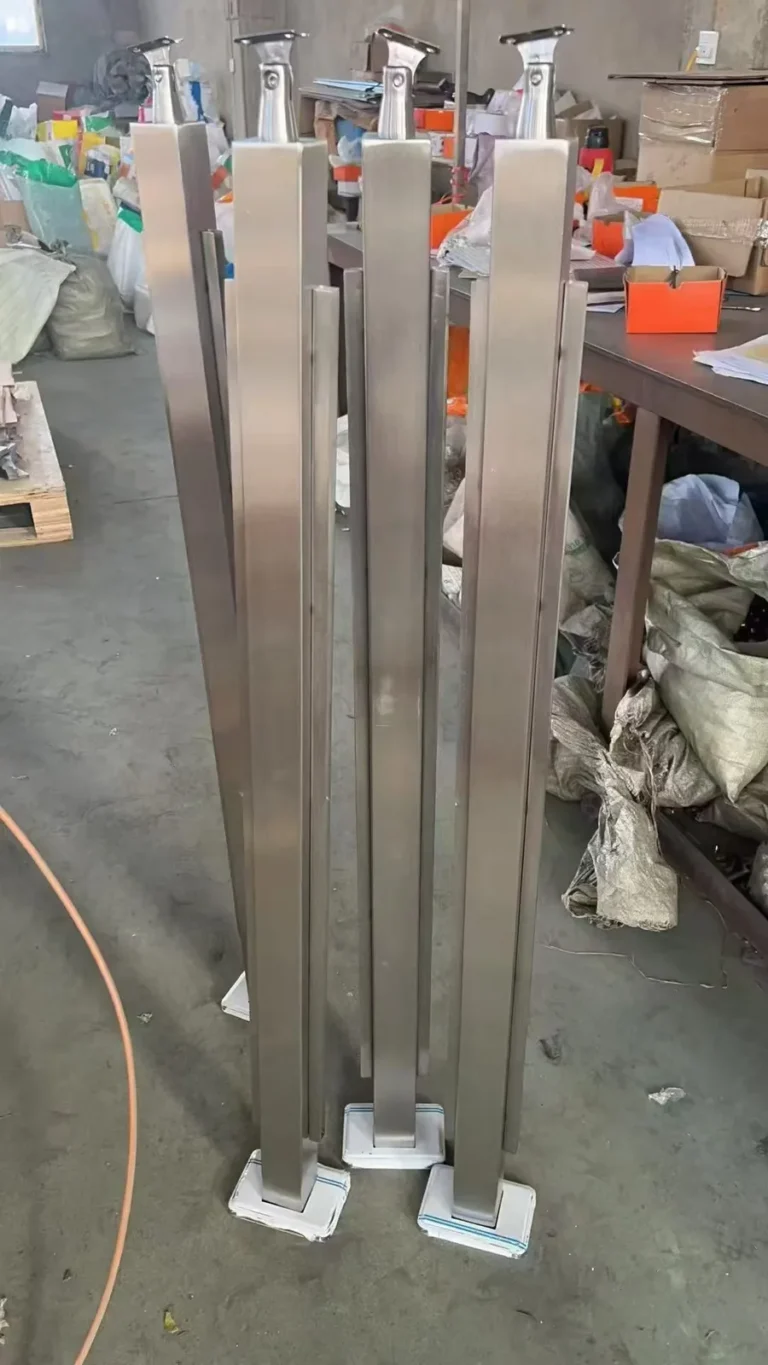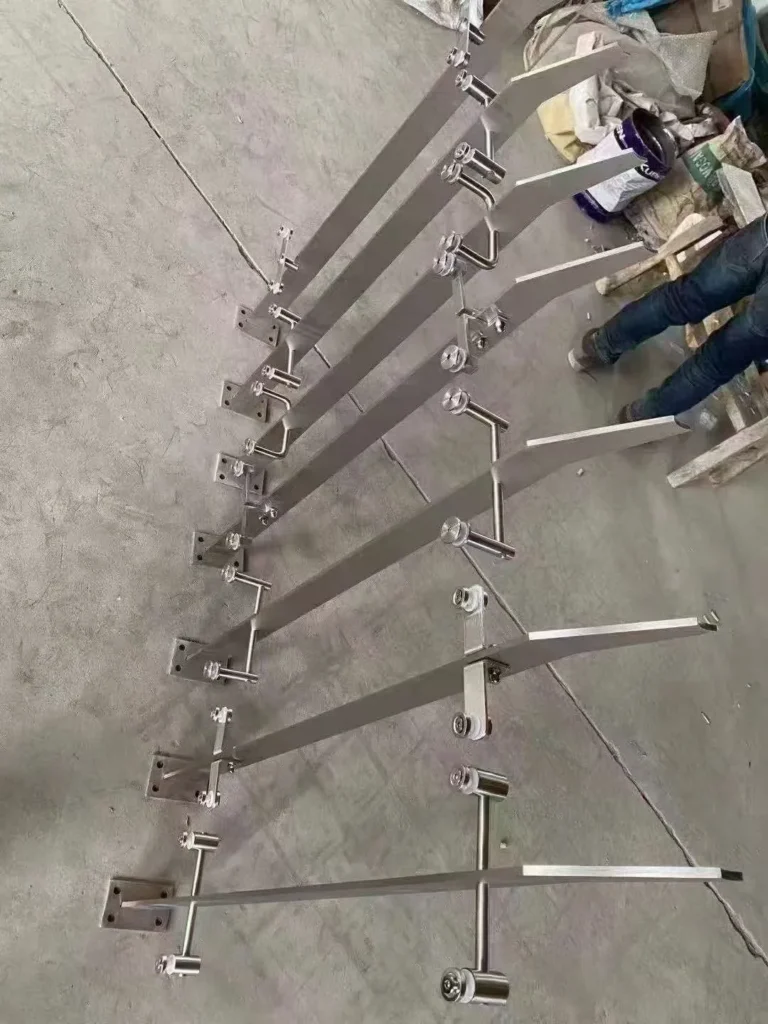
Short answer: choose a curved-blade stainless steel glass railing post when its sculpted profile fits the architectural line and the project can control direction, glass interfaces and handrail geometry by drawing. Buyers should treat left/right orientation, curve profile, fixing locations and finish as production-critical features, then approve a representative assembled post before the full batch.
What is a curved-blade railing post?
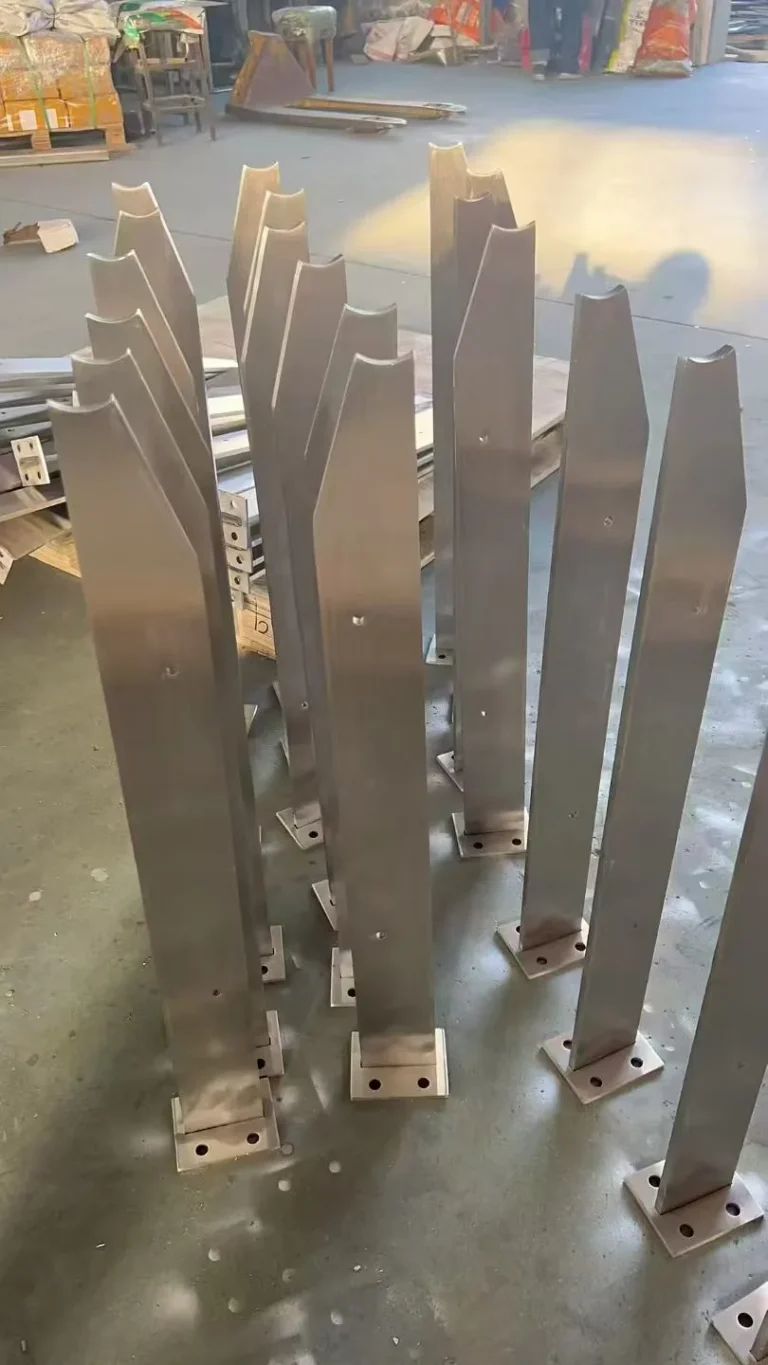
A curved-blade railing post uses a narrow stainless steel body with a shaped or swept upper profile rather than a uniform straight tube. The curve may lean toward a handrail, glass line or architectural feature. Depending on the design, the post can carry glass adapters, clamps, through-fixings or a separate support assembly.
“Curved blade” describes the form, not a universal standard size. Two posts can look similar in a rendering while having different curve radii, offsets, body thicknesses, glass reference lines and base connections. Final geometry must come from the approved production drawing.
When should a curved blade be selected?
The design works best when the curve has a deliberate relationship to the handrail or glass and can repeat consistently along the railing. It can create a lighter side elevation than a square tube and a more expressive profile than a straight flat bar.
It is less suitable when the installer expects to rotate any post freely, change the railing line on site or use one part for every level, corner and stair condition. A directional blade normally requires tighter variant control than a symmetrical round post.
| Selection factor | Curved blade | Straight flat bar | Square tube |
|---|---|---|---|
| Visual character | Sculpted and directional | Minimal and linear | Geometric and neutral |
| Orientation sensitivity | High | Medium to high when fittings are one-sided | Medium when faces differ |
| Handrail transition | Project-specific curve or support required | Notch, saddle or bracket | Commonly saddle or adjustable support |
| Variant control | Often needs mirrored and location-specific parts | Often needs level and stair variants | Can be more repeatable but still drawing-dependent |
| Inspection focus | Profile template, twist, orientation and interface alignment | Straightness, edge finish and hole layout | Face orientation, squareness and fitting positions |
The railing post types guide compares round, square and flat-bar formats at a broader system level.
Why must the curve direction be defined?
A curved post has a front, back and direction of sweep. If glass fittings are mounted to one face, rotating the post can move the glass away from the intended line. If the upper profile supports a handrail, mirroring the post may also reverse the transition.
Drawings should define orientation from a named viewpoint, such as “viewed from the walking side” or from gridline references. Use separate part numbers for left and right ends, inside and outside corners, stair-up-left and stair-up-right, or any other mirrored condition. Do not use “LH” and “RH” without defining how the observer faces the railing.
Which curve dimensions belong on the drawing?
A silhouette alone is not enough for production. Control the curve with dimensions that can be made and inspected. Depending on the design, the drawing may use radii, tangent points, offsets, reference coordinates, a full-size profile template or a controlled CAD geometry file.
At minimum, identify:
- Overall post height from a defined mounting datum.
- Blade width, thickness and material form.
- Start and end points of the shaped region.
- Forward or lateral offset at the top.
- Relationship between curve, glass line and handrail centreline.
- Permitted profile deviation and twist where functionally necessary.
- Edge treatment and which faces are architectural surfaces.
The drawing, datum and tolerance guide explains how to control interfaces without applying unnecessarily tight tolerances to every dimension.
How should the glass interface be specified?
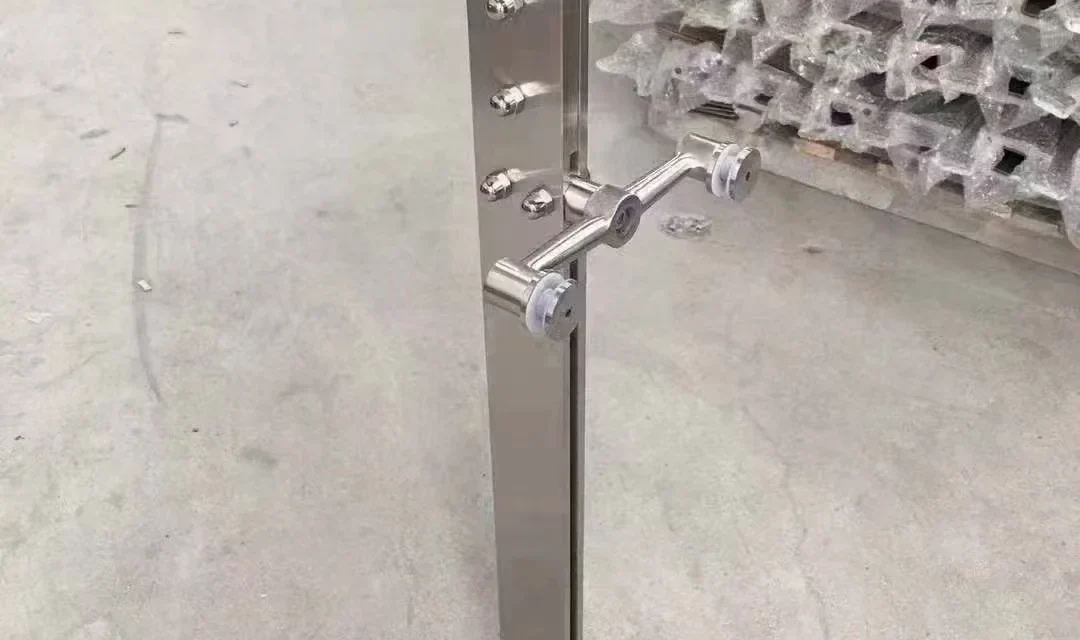
Start from the approved glass line, not from an uncontrolled post edge. State glass thickness, panel joint, fixing type, hole coordinates where relevant, gasket or bush arrangement and the face from which hardware is installed. Confirm tool access and whether the fitting can be tightened after adjacent panels are in place.
A curved blade can use discrete glass adapters, through-bolts, clamps or another engineered interface. The fixing needs sufficient clearance from the curved transition and from the base or handrail connection. A 3D model can reveal clashes, but the controlled manufacturing drawing still needs measurable datums.
The glass clamp selection guide covers glass thickness, gasket compatibility, load path and anti-slip considerations. Glass clamps and specialist accessories may come from qualified professional manufacturing resources rather than BalusterPost’s own post production, so their source and specification should remain explicit.
Does the curved top replace a handrail support?
Not automatically. Some designs bring the blade toward a top rail; others use a separate welded, fastened or adjustable support. The drawing must show the final rail cross-section, contact geometry, connection method and rail centreline.
Where the top rail also serves as a required handrail, project-specific rules for height, continuity, graspability and clearance apply. The US Access Board stairway guidance explains these issues for ADA-covered stairways. The project designer must identify the locally applicable building code; a post photograph cannot establish compliance.
How should level, corner and stair variants be scheduled?
Create a post schedule that ties every location to a part number and drawing revision. A typical project may need:
- Standard level intermediate posts.
- Level end posts with one-sided glass fittings.
- Inside and outside corner conditions.
- Stair or ramp posts at one or more slopes.
- Mirrored left- and right-hand posts.
- Transition posts between slope and landing.
- Posts with different top supports or glass-panel joints.
The quantity total can be correct while the variant mix is wrong. Reconcile the post schedule with plans, elevations and the approved purchase-order lines before production release.
What must be confirmed at the base?
Define top, side or fascia mounting and show the post body relative to the base plate or bracket. For a directional curved blade, the base-hole pattern and cover plate may appear symmetrical even when the post above it is not. Mark orientation so the installer does not rotate the post into the wrong direction.
The drawing should show plate size, thickness, hole centres, post-to-plate relationship, weld location and cover clearance. Anchor type, substrate capacity, edge distance, waterproofing and the complete structural design remain project responsibilities.
Which material and finish details matter most?
Specify stainless grade by component and select it for the environment, maintenance plan and project requirements. The curved form does not make one grade automatically correct. Base plate, post body, welded supports and critical fittings may need separate material records.
Curves make finish continuity visible. For brushed stainless steel, define grain direction through the transition and identify acceptable changes where forming or weld finishing affects the surface. For polished or coated finishes, approve a representative sample that includes the curve, edges, welds and adjacent hardware—not only a flat coupon.
How should curved profiles be inspected?
Inspection should combine measurable geometry and assembled appearance. Useful controls include:
- Verify material and blank dimensions before forming or machining.
- Check the profile against controlled coordinates, a gauge or approved template.
- Measure top offset and height from the defined base datum.
- Check twist so the upper profile, fittings and base share the intended planes.
- Verify glass-hole centres and fitting orientation from functional datums.
- Trial the rail support, glass hardware and base cover.
- Inspect weld finishing, edges and grain under agreed viewing conditions.
- Label the part number and handedness before packing.
Do not approve only the bare silhouette. The first-article railing post checklist helps connect drawing measurements, fittings, finish and assembly evidence before batch release.
How should the post be packaged?
The projecting curve and attached glass hardware can concentrate transport loads. Package the post so weight is carried by supported body areas, not by the shaped top, adapters or handrail fittings. Use clean separators between finished surfaces and prevent mirrored variants from becoming mixed.
Labels should show part number, drawing revision, handedness, package quantity and installation area where useful. Protective film alone does not stop bending or internal movement.
Common ordering mistakes
- Approving a rendering without the controlled curve geometry.
- Using one part number for mirrored left and right posts.
- Dimensioning glass holes from a curved or finished edge without a datum.
- Changing the rail profile after the post curve has been approved.
- Assuming the shaped top is itself a complete handrail connection.
- Inspecting height but not top offset, twist or fitting orientation.
- Letting installers decide post rotation from appearance alone.
- Packing finished posts with loads on projecting hardware.
How BalusterPost supports curved-blade posts
BalusterPost manufactures drawing-based stainless steel baluster posts and stainless steel railing posts, with business coordination from Taizhou, Jiangsu, China. The BP-CB01 curved-blade glass balustrade post is a real production model; final curve, mounting, glass connections, handrail interface and finish are confirmed for each project.
Send plans, elevations, glass details, rail section, post schedule, mounting condition and finish requirements. Contact Ryan Liang, Export Manager, with the controlled geometry rather than a reference image alone.
Frequently asked questions
Can a curved-blade post be rotated for left and right locations?
Only if every interface remains correct after rotation. One-sided glass fittings, a directional top and an asymmetric base usually require separate mirrored parts.
Is a CAD model enough for production?
A model is useful, but the manufacturing release should also define revision, datums, critical dimensions, tolerances and inspection method.
Can the curve be adjusted on site?
Site bending can damage finish, alter geometry and invalidate approved interfaces. Resolve the profile and variants before production unless an engineered adjustment method is specifically designed.
Does the curved top count as a handrail?
No. A required handrail must meet the applicable project’s continuity, height, graspability, clearance and connection requirements. The blade shape alone does not establish those conditions.
What should the first article include?
Use the correct base, glass hardware and representative rail connection, then inspect profile, top offset, handedness, hole layout, finish and assembly clearance.
What information is essential for quotation?
Provide the controlled curve geometry, material, finish, glass interface, handrail detail, mounting method, variant schedule, quantities and inspection requirements.