
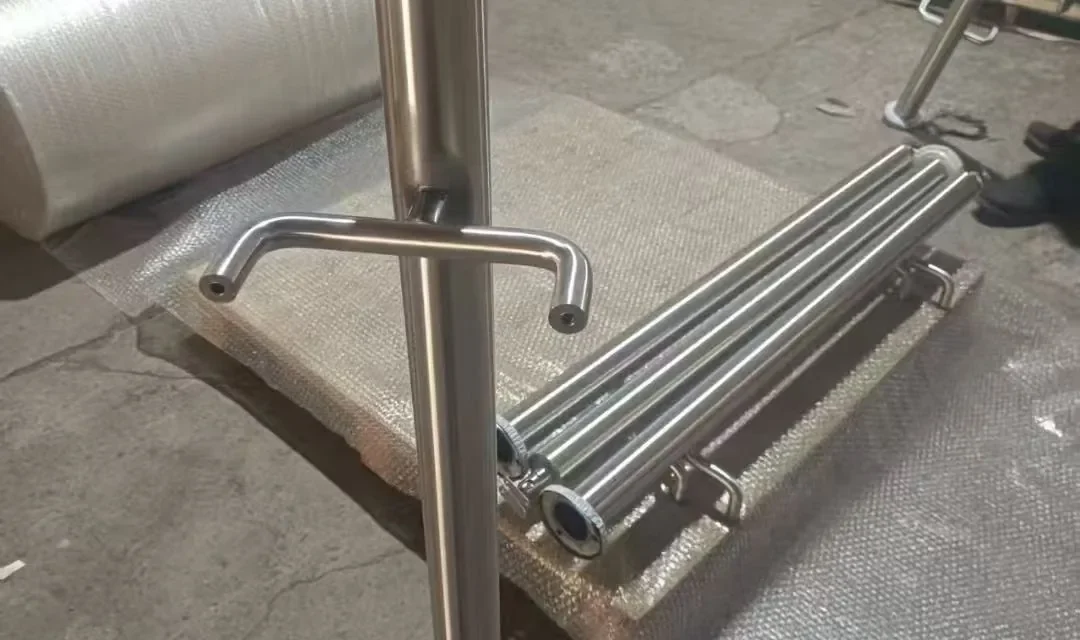
Choose a round stainless steel railing post by its complete connection layout, not tube diameter alone. Confirm the post’s position in the railing run, infill or glass interface, handrail-support geometry, mounting detail, material grade, finish and inspection drawing. A round tube can look identical from the front while its welded arms, base, fasteners or orientation make it unsuitable for the project.
Where does a round railing post make sense?
A round-tube post can support a continuous handrail, a glass or other infill system, or a project-specific guardrail detail. Its cylindrical body offers a different visual rhythm from a square tube or flat bar, particularly where a round handrail is used. The choice should start with the architectural detail and the interfaces the post must carry. A catalogue photograph is only a starting reference.
BalusterPost’s BP-RD01 round-tube handrail support post shows a real production configuration with fabricated arms. It is manufactured to the approved project drawing. Its photographed shape does not establish universal dimensions, glass compatibility or structural capacity for a different project.
Which configuration should the buyer request?
| Position | Detail to define | Common review point |
|---|---|---|
| Intermediate post | Repeated infill and handrail connection centers | Check alignment with adjacent posts |
| End post | Termination, exposed fasteners and finished side | Do not use an intermediate drawing unchanged |
| Corner post | Angle between railing runs and fitting orientation | Check access for both connections |
| Stair post | Pitch, handed direction and sloped handrail support | Separate left and right variants if needed |
| Transition post | Change from stair to landing or between infill types | Approve the complete assembly interface |
The list is a design checklist, not a set of standard BalusterPost stock models. The part schedule should assign a drawing revision and quantity to each distinct configuration. If a supplier must guess which arm faces the glass or handrail, the procurement definition is incomplete.
How do the infill and handrail connect to a round tube?
A fitting may attach through a welded arm, bracket, saddle, boss or other designed connection. The important questions are where its load path enters the post, whether its fastener can be installed and serviced, and whether the connection can be inspected after fabrication. Circular geometry can make a fitting’s rotational position as important as its height.
For glass, define the approved glass system, fitting type, center positions, projected distance from the post, gasket and fastener details, and required access for installation. For other infill, record the same functional information for the approved hardware. Glass clamps and related accessories can be coordinated through qualified specialist manufacturing resources; they are not presented as BalusterPost’s own manufactured products.
The handrail support needs its own drawing callout: rail profile, saddle or arm shape, height from a clear datum, lateral offset, angle, fixing method and visible finish. A round post and a round rail are not automatically compatible merely because their surfaces are curved. See the handrail-support selection guide for the available connection decisions.
Which round-tube dimensions belong on the drawing?
Specify outside diameter and wall thickness, finished post height, base-plate geometry, anchor-hole pattern, tube seam or visible-face requirement if relevant, fitting centers and angular orientation. Include the post-to-handrail offset and infill line relative to the structural mounting face. A drawing should identify the datum used to measure each critical feature.
In plan view, show the clocking of each arm or clamp around the tube. Define the angle from a stated reference plane, not from an ambiguous photograph. For a stair, show the ascent direction and the pitch in a dedicated view. The same front elevation can otherwise describe two different handed posts.
ISO 129-1:2018 sets general principles for presenting dimensions and associated tolerances on technical drawings. It does not choose functional tolerances for the designer. The project’s responsible designer must determine which positions, angles and clearances control fit. Our railing-post drawing guide shows how to document datums and inspection points.
How should the tube specification be stated?
First decide whether the specified tube is a mechanical or structural product and which standard, grade and condition the project requires. ASTM A554-26 is the current ASTM specification for welded stainless steel mechanical tubing, and its scope includes round shapes. The standard alone does not define a finished railing post, its welds, anchors, glass system or code compliance.
ASTM A1134/A1134M-26 is a separate specification for cold-formed welded stainless structural tubing in rounds and shapes. Buyers should not treat A554 and A1134 as interchangeable design approvals. The engineer or specification author must select the relevant material standard and verify that the actual tube and fabricated assembly meet the project’s requirements.
Where an ASTM designation is required, write the edition, grade, nominal tube dimensions and any supplementary requirements into the order. Where another regional standard governs, use the specified standard instead. Do not substitute a familiar designation without approval.
Should the post use 304 or 316L stainless steel?
Material selection depends on exposure, expected cleaning, surface finish, crevices and the project’s corrosion criteria. Grade names alone do not guarantee a stain-free result. The worldstainless corrosion guidance highlights the importance of chloride exposure, including coastal conditions and de-icing salt, when choosing an architectural grade.
Specify the required grade for the tube and every permanent stainless component, including welded arms, plates and relevant fasteners. Check that the finish and fabrication process are compatible with the required material. A 304 versus 316L choice should reflect the actual site and maintenance plan. Final selection remains a project engineering decision.
Which mounting details need approval?
A round post may use a top-mounted base plate or another project-specific fixing. Define the substrate, mounting face, plate dimensions, hole or slot pattern, edge conditions, cover, drainage, anchor specification and installation access. The visible cylinder does not reveal whether the base can transfer the required forces into the building structure.
Do not assume a plate that fits the drawing is structurally adequate. Anchor design, substrate capacity, load combinations, local code requirements and waterproofing need approval by the responsible project professionals. The mounting-method guide explains the different interface information needed for top, side and fascia fixing.
What should be checked before batch production?
- Confirm the approved revision and the schedule of intermediate, end, corner and stair posts.
- Verify tube outside diameter, wall, grade and traceability evidence against the order.
- Measure finished height, base pattern, arm centers, projection and rotational orientation.
- Review weld location, continuity, appearance and access against the accepted drawing and project criteria.
- Test-fit the actual approved handrail and infill hardware or controlled mating samples.
- Compare the brushed or polished finish with the approved reference under agreed lighting.
- Check that covers, tools and fasteners can be fitted after installation.
- Record deviations and obtain written disposition before releasing the batch.
A first article is most useful when it represents the most complicated configuration, not only the simplest repeated post. For project-specific checks and a sign-off sequence, use the first-article inspection guide.
What belongs in an RFQ for round railing posts?
Include the project location and exposure, intended application, approved elevations and sections, post-type schedule, quantities, tube and grade specification, material records, mounting detail, infill connection, handrail profile, finish reference, inspection criteria, packaging identification and required delivery destination. Mark open engineering questions instead of filling them with assumptions.
Provide DWG, DXF or PDF drawings where available and identify which version controls. A photograph or existing sample can clarify appearance and fabrication, but it cannot replace the approved dimensions or engineering requirements. If the buyer wants the BP-RD01 style, identify exactly which photographed features to retain and which must change.
BalusterPost focuses on manufacturing stainless steel baluster and railing posts, with business coordination based in Taizhou, Jiangsu, China. Ryan Liang is the Export Manager. Related hardware can be coordinated through qualified specialist manufacturing resources. Send the drawing and RFQ through the BalusterPost enquiry page.
Frequently asked questions
Is a round post suitable for a glass railing?
It can be when the complete post, fitting, glass and mounting system is designed and approved for that project. A round tube by itself does not establish glass compatibility.
Can one drawing cover straight and stair posts?
A common design family may share notes, but each distinct pitch, handed direction, fitting position or handrail transition should be clearly scheduled and dimensioned.
Does ASTM A554 certify the assembled railing?
No. It is a tubing specification. The fabricated post, connection system, structural design and installation require their own project-specific verification.
Can a sample replace a drawing?
A sample helps explain construction and finish. A controlled drawing is still needed to define the intended dimensions, variants and acceptance requirements for repeat production.
What is the most common avoidable purchasing ambiguity?
Leaving fitting orientation unstated. Record each arm or clamp’s angular position and height from explicit datums so the post can be fabricated, inspected and installed consistently.




