
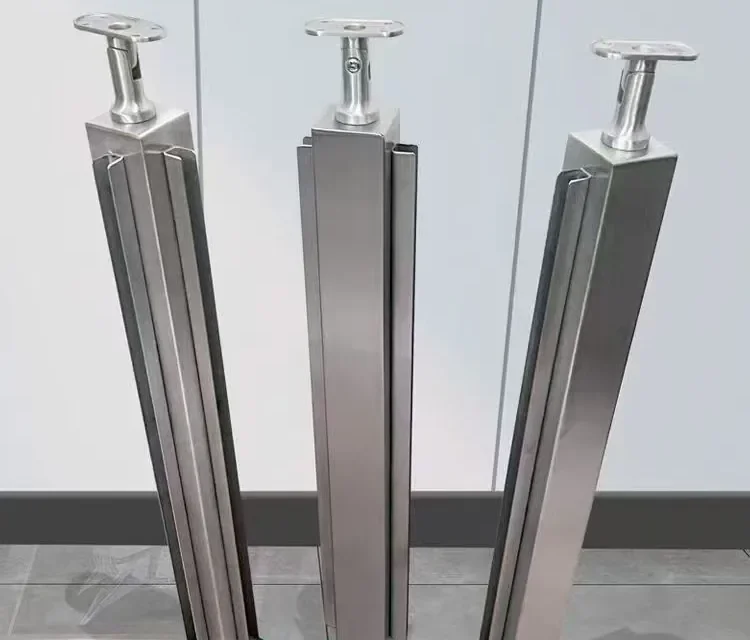
To specify a square stainless steel railing post for a glass balustrade, define the complete assembly—not only the tube size. The approved drawing should identify the post profile, material and finish, glass-side face and fitting centres, handrail support, mounting interface, and each end, corner or stair variant. A square profile gives four orientation references, but it does not make different posts interchangeable or prove the finished railing meets project loads.
When is a square-tube post the right product form?
A square tube gives the designer broad flat faces for locating a handrail saddle, glass-side clamps or fabricated adapters. Its straight edges also make the intended orientation easy to show in an elevation and plan. Those are coordination advantages, not a claim that a square post is inherently stronger or safer than a round or flat-bar post. Section size, wall, connection details, spacing, material and the complete load path must be selected for the project.
BalusterPost’s BP-SQ01 square-tube glass balustrade post is a real core manufactured post model with custom clamp positions and top support. Its page lists SS304 and SS316L options, brushed or satin finish and project-specific dimensions. It is a starting configuration, not a fixed universal size. The post-type comparison guide explains where square, round and flat-bar forms differ at a higher level; this guide addresses the purchase decisions once a square form is chosen.
For a buyer comparing photographs, look beyond the silhouette. Two square posts can have identical tube bodies yet different hole positions, welded brackets, saddle angles, base plates or finishes. The quotation should identify which configuration is being offered for each location.
Which square-profile details must the drawing show?
Specify the outside profile, wall thickness, cut length, grade, seam or face orientation where relevant, finished edges, any drainage or closure detail, and surface finish. If a tubing standard is contractually required, name the edition and purchaser options rather than writing only “stainless tube.” ASTM A554-26 covers welded stainless mechanical tubing in round, square, rectangular and special shapes; it does not approve the completed post, welds, anchors or guard system. A project may use another applicable product specification, so the buyer should not automatically impose A554 on every component.
Use a consistent datum scheme: bottom of finished post or base plate, a designated front face, and a clearly marked glass side. Dimension fitting centres from controlled datums rather than a chain of estimated photograph measurements. Show whether the glass lies inside or outside the post line and which face receives fittings. Our drawing and tolerance guide explains why mating-hole centres and handed orientation need approval before fabrication. It does not set a universal tolerance for every glass system.
A sample photo can communicate visual intent, but it cannot prove tube wall, grade, hole centres or handedness. Request a production drawing and a type mark that appears on the quote, sample and package label.
How should the glass connection be specified?
Identify the actual infill system first: glass thickness and build-up, panel layout, glass edge position, fitting family, gasket or insert, number of fittings per post, orientation and service access. A clamp on a flat square face is not automatically interchangeable with a welded glass adapter. The post may need threaded holes, through-holes, welded tabs or a different wall or reinforcement detail, depending on the approved fitting. The glass-clamp specification guide covers fitting-side questions in depth.
BalusterPost manufactures the stainless steel post. Glass clamps and other related fittings can be coordinated through qualified specialist manufacturing partners; they should not be described as BalusterPost’s own manufactured products. Ask the quotation to say whether the fitting, gasket and fasteners are included, supplied separately or provided by the buyer. The post-to-fitting interface still needs one controlled drawing even when the parts have different supply origins.
At a corner, the glass may approach two faces or require a changed panel plane. At an end, the unused face may need a different finish or a cap. On a stair, the glass and handrail may be sloped while the post must remain plumb. Do not create these variants by rotating a middle post in the installation drawing unless its fittings, base and finish have been checked for that orientation.
What does the handrail interface change?
Define whether the rail is top-mounted, side-connected or absent. For a top saddle, record the rail profile, saddle shape, angle, fixing method, centreline offset and whether the support is fixed or adjustable. An adjustable support does not remove the need to define its permitted range and final fixing detail. A straight balcony, sloped stair and level landing transition may need different top pieces even if all have the same square tube.
Keep the post type mark tied to the matching handrail support and fixing set. If the rail is supplied by another contractor, request its actual section drawing before the post top is finalized. An approximate rail diameter or a “standard saddle” label is not enough to prove fit. Where a project requires continuous handrail geometry, the designer must coordinate joints and changes of direction across multiple posts.
How do top, side and fascia mounting affect the square post?
The mounting choice changes the lower assembly and the relationship between the post centreline and the structure. A top-mounted base plate may sit within the finished walking surface. A side or fascia mount connects to a vertical structural face and may need a side plate, bracket, offset or handed version. The decorative cover is a separate item from the load-carrying plate. Our mounting-method guide compares the concepts and coordination risks.
For procurement, supply a plan and section through the real slab or steel edge. Show substrate, finished surface, waterproofing, cladding, glass line, post offset, plate and hole pattern, and installation access. Do not derive an anchor size, embedment or capacity from a post catalogue image. Those are project engineering decisions that require the actual loads and supporting structure. The post fabricator needs the approved interface to make the correct plate and holes.
If a side-mounted post has an attractive clear floor line but the installer cannot reach the back of the bracket after cladding, the configuration is not installation-ready. Resolve access and inspection sequence before approving the production drawing. A removable cover should not conceal an unresolved fixing or drainage issue.
How should material and finish be chosen?
Choose the grade for the actual exposure, not merely for a generic “outdoor” label. The British Stainless Steel Association’s guidance for building exteriors considers site type, local conditions, finish, orientation, rain washing and maintenance. It notes that coastal, industrial and other harsh microclimates can alter grade selection. This is selection guidance, not a substitute for the project specification or a corrosion-life guarantee.
On a square post, adjacent faces make inconsistent brushing or polishing easy to see. Define the visible faces, grain direction, weld blend, acceptable sample and protection during handling. If a base cover, saddle or coordinated fitting uses a different material or finish, identify that separately. Do not assume “316L post” means every hidden plate, fastener and sourced clamp is also 316L. Require the grade and finish of each relevant item in the approved bill of materials.
Which variants should become separate line items?
| Variant | Square-post decision | Why a separate drawing may be needed |
|---|---|---|
| Middle | Glass and handrail connections along a straight run | Baseline fitting count and centres |
| End | Terminal rail, exposed outer face and final glass edge | Different cap, saddle or face finish |
| Corner | Two panel directions and rail turn | Face orientation and connection offsets change |
| Stair | Slope, ascent direction and landing transition | Angled support and left/right variants |
| Side or fascia mount | Offset, bracket and access side | Different lower connection and handing |
This is a variant-planning table, not a claim that all projects require every type. One type mark may cover several locations only when the posts are genuinely interchangeable. Match the final quantity by type to the approved layout rather than a total count of visually similar posts.
A practical RFQ and first-sample check
- Send elevations, sections and the post location schedule; mark glass side, inside/outside and direction of ascent.
- State square tube profile, wall, grade, finish and applicable product standard if one is required.
- Provide the exact glass fitting and handrail connection drawings, including coordinated partner-sourced items.
- Show each base or fascia connection and name who designs and supplies structural anchors.
- Separate middle, end, corner, stair and handed variants; assign drawing revisions and quantities.
- Approve a representative sample or first article against critical dimensions, fitting centres, visible finish and package label before volume production.
Send the controlled drawings and quantities through the BalusterPost enquiry page. Ryan Liang, Export Manager, coordinates enquiries from Taizhou, Jiangsu, China. A project-specific quote should state exactly which post variants and coordinated fittings are included; it cannot be inferred from one photograph.
FAQ
Is a square stainless post stronger than a round post?
Not as a general rule. Capacity depends on the selected section, wall, material, connections, post spacing, loads and support structure. The project engineer must assess the complete assembly.
Can the same square post be turned to use on the other side of a balcony?
Only if its holes, fittings, handrail support, base and visible finish remain correct after rotation. Many configurations are handed. Confirm from the approved plan and type mark before treating them as interchangeable.
Are glass clamps automatically included with the post?
No. State the fitting model, quantity, gasket and fastener scope in the quotation and bill of materials. BalusterPost’s core manufacturing product is the stainless post; related clamps may be coordinated from specialist partners.
Can one BP-SQ01 product photo replace the project drawing?
No. BP-SQ01 shows a square-tube post family, while final height, fitting positions, glass specification and mounting follow the approved project drawing. A photo does not establish those dimensions or engineering approval.




