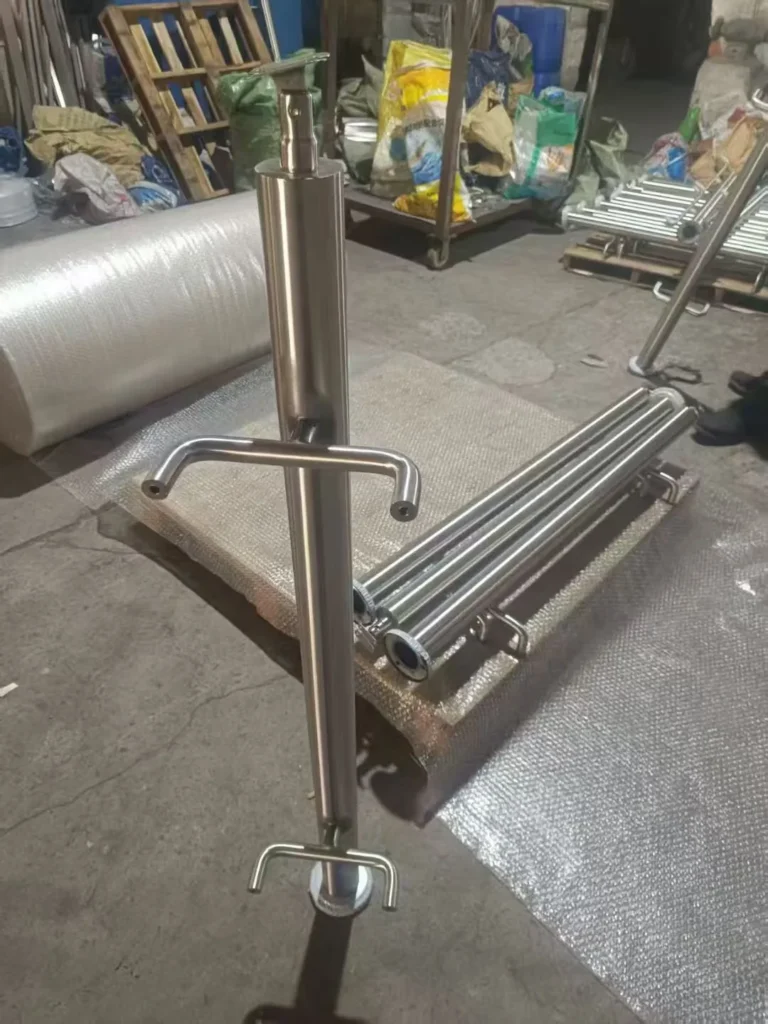

Short answer: verify stainless steel railing post material with a linked evidence chain, not one document or one analyser reading. The purchase specification should connect the ordered grade to the mill test certificate, heat or lot identity, incoming material, cut components and finished posts. Use PMI as a defined verification tool, while recognising its method, surface and sampling limits.
Why material verification needs more than “304” or “316L”
A stainless steel grade written on a quotation is a requirement, not proof. A finished railing post may combine tube or flat bar, base plate, handrail support, glass adapters, fasteners and weld filler. These items can come from different heats, lots or specialist suppliers. The buyer needs to know which components are grade-critical and what evidence follows each one.
Material verification should answer three separate questions:
- Specification: what grade and product form did the purchase order require?
- Traceability: can the finished item be linked back to the relevant incoming material and its records?
- Verification: what independent or in-process check confirms that the material identity is credible?
No single certificate, stamp or handheld reading automatically answers all three.
What is a material test certificate?
A material test certificate, often called an MTC, MTR or mill certificate, reports information for a material heat, batch or product under a stated specification. Depending on the ordered material and certificate type, it may include producer identity, material designation, heat number, dimensions, chemical analysis, mechanical test results and the authorised validation.
The certificate must be reviewed against the purchase order and material form. A certificate for stainless sheet does not automatically cover a tube, bar or base plate merely because the grade name is the same. Likewise, a PDF labelled “316L certificate” is not useful if the heat number cannot be connected to the material used in the posts.
ASTM A751-25 provides test methods and practices for chemical analysis of steel products. It is a chemical-analysis framework, not a promise that every commercial MTC includes every test a railing buyer may want. The applicable product specification and purchase order determine the required tests and reporting.
What should buyers check on an MTC?
| Certificate field | Buyer check | Common limitation |
|---|---|---|
| Producer and document identity | Is the issuer identifiable and can the document be authenticated? | A supplier-created summary may not be the original producer record. |
| Material grade | Does it match the ordered designation and governing specification? | Similar grade names across standards are not always interchangeable. |
| Heat or lot number | Does the identifier appear on tags, material records or traceability logs? | A certificate without a physical or recorded link cannot identify the used stock. |
| Product form and size | Does it cover tube, flat bar, plate or other supplied form? | One heat may be processed into several forms with different product requirements. |
| Chemical results | Are reported elements within the applicable grade limits? | A report may show heat analysis rather than a result taken from the finished post. |
| Mechanical results | Are required values present for the ordered product specification? | Results may not be required or representative for every component. |
| Certificate status | Is it the required certificate type and properly validated? | A generic certificate copy may not meet project documentation terms. |
Buyers should also check for altered fields, mismatched fonts, missing pages and certificate quantities that do not fit the order. These are review flags, not automatic proof of misconduct. Resolve discrepancies with the supplier and, when necessary, the issuing mill or an independent inspection body.
What is PMI and what can it prove?
Positive Material Identification (PMI) uses an analytical method to check alloy chemistry or identify an alloy family. Portable X-ray fluorescence (XRF) is widely used because it can identify many alloying elements without cutting a laboratory sample. It can be valuable for checking that material marked as 316 contains the expected molybdenum response and is not a common 304-type alloy.
However, PMI is not automatically a full chemical certification. The result depends on the instrument, calibration, reference library, measurement method, surface condition, operator and test location. A displayed grade match is the instrument’s interpretation of measured elements; buyers should retain the elemental results and test details, not only a photo of the grade name on the screen.
Evident’s XRF PMI guidance explains that XRF is a surface measurement and cannot detect some light elements, including carbon. This matters because a handheld XRF reading cannot establish the low-carbon “L” suffix in 304L or 316L. A suitable laboratory or optical-emission method may be needed where carbon content must be verified.
Can XRF distinguish 304 from 316?
XRF can usually help separate common 304-type and 316-type stainless steels because molybdenum is a key differentiator detectable by the instrument. But this should not be reduced to a single universal number. The result must be compared with the correct material specification, instrument capability and acceptance procedure.
ASTM E572-21 covers X-ray emission spectrometric analysis of stainless steel for specified elements and concentration ranges. It also notes the need for calibration and appropriate reference materials. A portable PMI programme should name the procedure, calibration checks, sample preparation and reporting rules rather than cite “XRF tested” without detail.
Why does surface preparation matter?
XRF reads the surface region presented to the analyser. Dirt, paint, protective film, plating, scale, transferred metal, polishing residue or a coating can affect the reading. The test location should represent the base material and be prepared by an approved method that does not introduce contamination or unacceptable cosmetic damage.
On finished architectural posts, decide before production where PMI will be performed. Testing an inconspicuous base area or retained material coupon can reduce appearance risk, but the traceability link to the finished post must remain controlled. Testing through packaging film or on a mixed-metal fitting does not verify the post body.
How should traceability continue through fabrication?
A mill certificate only becomes useful when its identity survives cutting and fabrication. A practical route is:
- Receive each material form with supplier, grade, size, quantity and heat or lot identity.
- Review the certificate against the purchase requirement before releasing material.
- Assign an internal material or batch identifier where original marking will be lost.
- Transfer the identity to the cut list, traveller, job card or controlled production record.
- Prevent unmarked remnants from returning to unrestricted stock.
- Link finished-post batch numbers to the consumed material records.
- Record substitutions and obtain approval before using a different heat, source or grade.
Traceability can be full or lot-based depending on project risk and contract requirements. The buyer should state the required level before quotation because individual-piece identification requires different handling from batch control.
Which post components need separate evidence?
Start with components that affect exposure, structural load path or the specified stainless appearance. The post body, base plate, welded support, adapter and critical fastener may not share one heat. Weld consumables are also separate materials and should follow the approved welding procedure and purchasing specification.
Related glass clamps or specialist fasteners may come from qualified professional manufacturing resources rather than BalusterPost’s own post production. Their supplier documents and PMI route should remain explicit. Do not extend a tube certificate to every accessory in the shipment.
How should a PMI sampling plan be written?
“PMI required” is incomplete. The inspection plan should define:
- Components and grades within scope.
- Whether inspection is 100 percent or sample-based.
- Sampling unit: piece, batch, heat, material form or shipment.
- Test method and instrument type.
- Calibration and reference-check requirements.
- Approved test locations and surface preparation.
- Elements or grade criteria used for acceptance.
- Retest, segregation and nonconformance procedure.
- Report fields, photographs and linkage to item or batch identity.
A sample result applies only to the defined sampling population. It should not be reported as “all posts verified” unless the sampling plan and traceability system support that conclusion.
What does not reliably verify stainless grade?
- Appearance: 304 and 316L can look identical after finishing.
- Magnet response: cold work and welding can affect magnetic response; a magnet is not a conclusive grade test.
- Supplier label alone: labels need a controlled link to purchasing and receiving records.
- One certificate for the order: several material forms or heats may be present.
- One XRF reading: it verifies one location under one measurement condition.
- Price: a higher price does not establish chemistry or traceability.
The 304 versus 316L railing post guide explains how grade selection should follow exposure and maintenance conditions. Material verification confirms the specified choice; it does not decide which grade the project needs.
What should be added to the RFQ and inspection plan?
State the grade and governing product specification for each major material form. Then define certificate type, heat or lot traceability, PMI scope, test method, sampling, acceptance criteria, report format and treatment of nonconforming material. Include whether the buyer or third-party inspector must witness any checks.
Connect these requirements to the OEM railing post RFQ checklist and the first-article inspection checklist. The broader railing compliance documents guide helps keep material evidence separate from project-code approval and product conformity claims.
How BalusterPost supports material verification
BalusterPost manufactures drawing-based stainless steel baluster posts and stainless steel railing posts, with business coordination from Taizhou, Jiangsu, China. Material certificate collection, batch identification and PMI requirements can be organised according to the agreed order and inspection plan. The exact evidence available depends on the specified material form, source and verification scope.
Review a representative square-tube glass balustrade post, then contact Ryan Liang, Export Manager, with the grade, product specification, traceability level and PMI sampling plan required for your project.
Frequently asked questions
Is an MTC enough to prove a finished post is 316L?
Only when the certificate is authentic, covers the correct material and is linked through controlled traceability to the finished post. Additional PMI or laboratory testing may be specified according to project risk.
Can handheld XRF verify the “L” in 316L?
No. XRF generally cannot measure carbon, so it cannot establish the low-carbon suffix by itself. Use a suitable analytical method where carbon verification is required.
Should every post receive PMI?
That is a procurement decision based on risk, traceability and contract requirements. If sampling is used, define the lot and selection method clearly.
Does PMI replace the mill certificate?
No. PMI checks material at a location; the MTC provides producer and test information for the identified material. A strong verification plan uses each for its proper purpose.
Can one tube certificate cover the base plate and fittings?
No automatic assumption should be made. Different components may use different heats, product forms or suppliers and need their own evidence route.
What should happen when a PMI result does not match?
Segregate the affected material, preserve its identity, check the instrument and procedure, retest according to the plan, investigate traceability and obtain disposition approval before use.